Cable carrier speed and acceleration limits
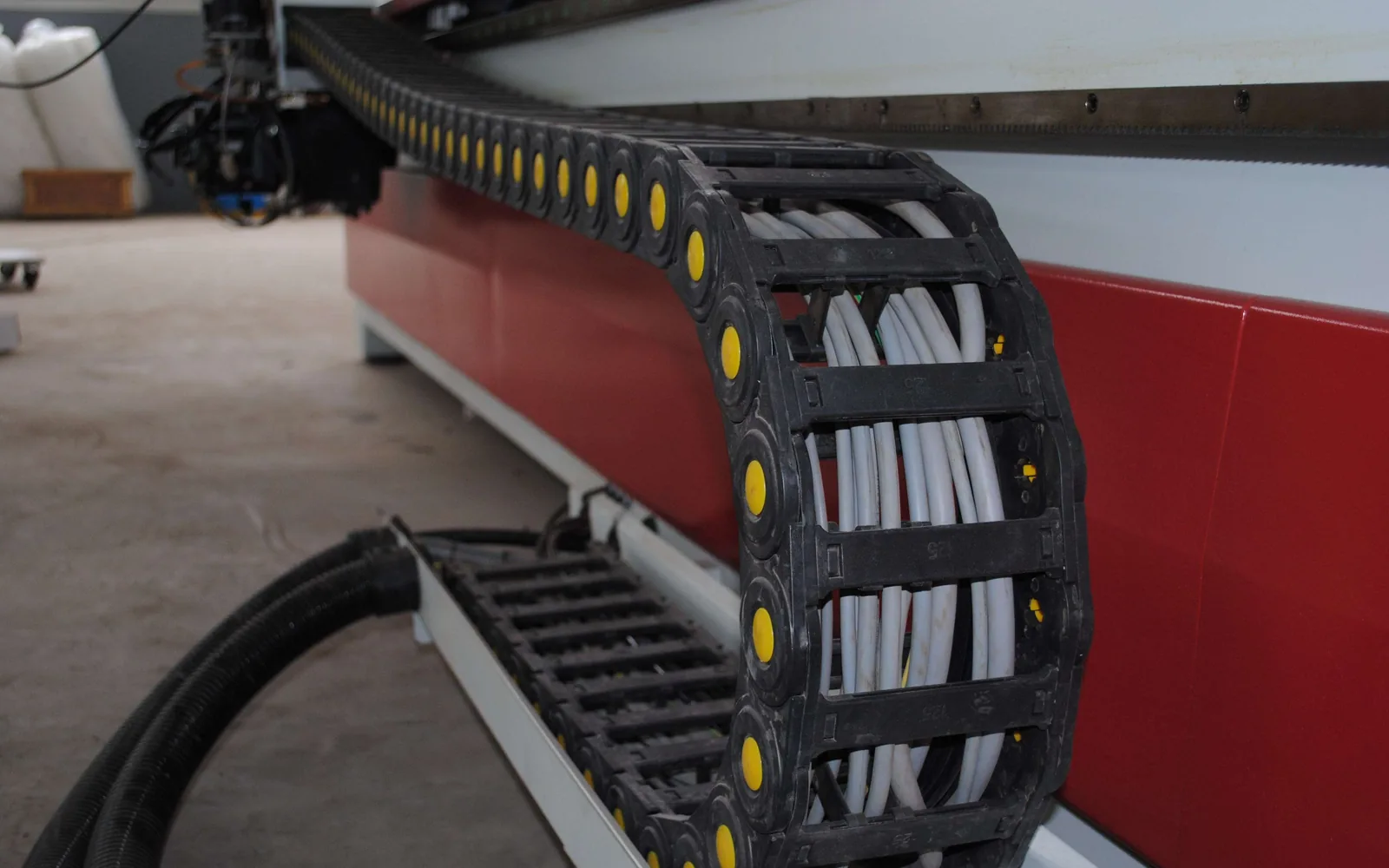
Peak speed alone is not a selection input. How stroke, cycle time and acceleration set the real limits for a silent cable carrier, plus the four data sets to send your supplier.
"This machine runs at 3 m/s — can your cable carrier take it?" We hear that question dozens of times a month, and it is the hardest one to answer in a single sentence.
The difficulty is that speed on its own is not a usable selection input. The same 3 m/s over a 2 m stroke and over an 8 m stroke are completely different duties for a carrier. Add the acceleration value on top, and the dynamic load on the links and pins can differ by more than a factor of two. Selecting a chain from a single speed figure is guesswork.
This article breaks the calculation order for high-speed silent applications into steps, from machine cycle time all the way down to a part number. Along the way it covers which data the supplier needs, and which parameters must come with a test report rather than a claim.
1. Get the order right: speed is an output, not an input
There is only one correct derivation chain, and reversing the order produces wrong numbers:
- Cycle time — how many seconds one complete reciprocating cycle takes
- Stroke — how far the moving end travels one way (call it S); one round trip is 2S
- Average speed — 2S ÷ cycle time
- Peak speed — read upward according to the shape of the speed profile
- Acceleration — peak speed ÷ acceleration time
- Bend radius and support method — derived from the four steps above
Most high-speed problems come from jumping from step 3 straight to "pick a part number" and skipping steps 4 and 5.
2. Acceleration hurts more than speed
A real machine does not move with a square-wave profile. It follows either a trapezoidal profile (acceleration phase, constant-velocity phase, deceleration phase) or a triangular one (no constant phase at all, accelerating or decelerating throughout).
Two geometric relations are worth memorising. They come from the area under the speed–time curve; they are mathematics, not product data:
- Trapezoidal profile: peak speed ÷ average speed = 1 ÷ (1 − fraction of the cycle spent accelerating)
- Triangular profile: the acceleration phase is fixed at 50%, so peak speed is exactly twice the average speed
A concrete example: a 1.2 m stroke on a 0.8 s cycle (one round trip) gives an average speed of 3 m/s. On a triangular profile the peak speed reaches 6 m/s; if the acceleration phase takes only 25% of the cycle, the peak is about 4 m/s. A full factor of two apart.
Once peak speed is known, acceleration is simply peak speed ÷ acceleration time. What the links actually carry is the inertial force F = m·a, where m is the chain's own mass plus the cables inside the cavity. Double the acceleration and you double the dynamic load on the hinges, pins and side plates. Speed only determines how fast it travels; acceleration determines how fast it wears out.
So of all the figures you send a supplier, acceleration — or the acceleration time — matters more than peak speed. Hand over a bare "3 m/s" and the supplier will either size up one step for the worst case, which costs money, or take a gamble.
3. Why a silent carrier can handle high speed
A silent cable carrier is not a standard chain with a noise pad glued on. Three things change at the structural level:
- Low-friction hinges — the sliding pair between links is replaced by a mating surface with a smaller contact area and a lower coefficient of friction, so sliding heat and wear at the hinge drop together during high-speed reciprocation.
- Optimised link contact geometry — adjacent links spread the impact over a face contact instead of a hard collision, which flattens the peak of the impact noise.
- Glass-fibre reinforced nylon — balancing stiffness and wear resistance, with a nominal operating temperature of -20 °C to 120 °C, the same as the standard nylon ranges.
In plain terms, it is designed for the job of moving continuously — not a quiet version of an ordinary chain.
4. Four parameters, calculated in this order
4.1 Bend radius R: the faster it runs, the higher R must go
The bend radius sets the bending strain in the cables. The higher the speed, the more times per unit time a cable is bent and unbent; with an undersized R, the strain per cycle is higher and conductor fatigue and jacket cracking arrive earlier.
A practical rule: for the same stroke, take the R value at least one step higher for a high-speed duty than for a low-speed one. Do not pick R on the basis of "it fits".
The silent range offers R values from R28 up to R200, so there is usually room to move up. See the specification table at the end of this article.
4.2 Acceleration: request an envelope curve, not a single number
Speed and acceleration are not two independent ceilings. They form an envelope curve — the higher the speed, the lower the acceleration the chain will tolerate, and the two trade against each other.
When you ask a supplier, ask specifically for the permissible speed–acceleration combination curve, not for a "maximum speed of X m/s". A bare maximum speed is meaningless in engineering: at very low acceleration a chain may survive a high speed, and conversely a low speed with a high acceleration can tear the links apart.
4.3 Stroke and support method
Once the stroke gets long, the unsupported span has to be treated separately:
- The self-weight of the unsupported span (chain plus cables) creates a continuous bending moment at the curve
- At higher speeds a dynamic load factor is superimposed on top of it
- For horizontal installation with a long unsupported span, adding a guide trough or support rollers is usually more economical than simply going one size up, and it addresses the cause rather than the symptom
4.4 Fill ratio: press it down for high-speed duty
As a general rule the total cable cross-section should not exceed 60% of the carrier's inner cavity cross-section. For high-speed reciprocation we recommend staying below 50%: the amplitudes of cable movement inside the cavity grow with speed, and an over-filled cavity makes cables rub against each other and press against the side plates.
Note that fill ratio is an industry rule of thumb, not a product specification. The final figure should come from the supplier's calculation against your actual cable list.
5. Higher speed means a longer safety distance
If the station where the carrier runs involves manual loading, or opening a guard for inspection, speed stops being only a service-life question.
The stopping distance after an emergency stop is proportional to the square of the speed and inversely proportional to the deceleration: double the speed and, at the same deceleration, the stopping distance becomes roughly four times as long. That calculation belongs to the machine's safety circuit. Relevant requirements can be found in EN ISO 13849-1 (safety of machinery — safety-related parts of control systems) and ISO 13855 (positioning of safeguards with respect to the approach speeds of parts of the human body). The carrier's routing and support brackets must not intrude into the resulting safety distance.
Separately, keeping a cable flexible while it moves is primarily the cable maker's responsibility, not the carrier supplier's. Ask the cable manufacturer for mechanical test data on insulation and sheath, using test methods along the lines of the IEC 60811 series, and get the minimum bend radius and flex life confirmed in writing.
6. Silent range specifications at a glance
| Series | Models covered | Inner height | Inner width | Available bend radii |
|---|---|---|---|---|
| Silent 18 | WSL01J | 18mm | 25–50mm | R28 / R38 / R48 / R55 |
| Silent 25 | WSL02J, WSL02JL, WSL03J | 25mm | 25–110mm | R55 / R75 / R100 / R125 |
| Silent 30 | WSL04J, WSL05J | 30mm | 25–110mm | R55 / R75 / R100 / R125 |
| Silent 35 | WSL06J, WSL06J2, WSL07J | 35mm | 25–125mm | R75 / R100 / R125 / R150 |
| Silent 40 | WSL08J, WSL09J | 40mm | 50–125mm | R75 / R100 / R150 |
| Silent 45 | WSL10J, WSL11J | 45mm | 50–125mm | R75 / R100 / R125 / R150 / R200 |
The whole range is glass-fibre reinforced nylon with a nominal operating temperature of -20 °C to 120 °C. The widths above are the standard inner-width steps; non-standard inner widths or non-standard R values require separate confirmation of tooling and lead time. The full dimensional tables are on the silent cable carrier series page, for example the Silent 25 series.
7. Four data sets to confirm before ordering
Send all four at once and you will cut a large part out of the selection cycle:
- Stroke and cycle time — one-way travel S, and the seconds per reciprocating cycle
- Speed profile — trapezoidal or triangular, and the acceleration/deceleration time (or the acceleration directly)
- Mounting method — horizontal or vertical, unsupported or in a trough, and how long the unsupported span is
- Cable list — outer diameter and quantity of each cable, whether air lines or fibre optics are included, and each one's permitted minimum bend radius
If you are unsure how to work it out, run through the selection calculation process with your stroke, speed and acceleration, or send us the parameters and we will work it out for you.
8. Frequently asked questions
Is a silent carrier always required for high speed?
No. The silent range solves noise and vibration during high-speed reciprocation. If the station is not noise-sensitive and the speed is moderate, the standard nylon ranges are sufficient. Conversely, if your real problem is particle emission rather than noise, do not look at the silent range — the cleanroom WWC range addresses a different requirement, uses TPU, and follows a different selection logic.
How fast can a silent cable carrier run?
That cannot be answered in one number, for the reason given in section 4.2: the speed limit depends on the acceleration paired with it. Give us the speed profile and we will calculate against the envelope curve rather than quote a "maximum speed".
Can we audit the factory?
Yes. The manufacturing entity is in Yueqing, Zhejiang (Shifan Street), and factory audits and sampling are arranged there, where the production lines and tooling can be inspected on site. Changzhou is our resident sales office for day-to-day contact — not a factory.
What is the lead time?
Standard sizes that are held in stock ship fastest; non-standard inner widths or non-standard R values require tooling, and the lead time must be confirmed separately. Warehouses are located in Dongguan, Foshan and Shanghai.
Conclusion
The hard part of speed selection is not "how fast can it run" but stating cycle time, stroke and acceleration clearly in one go. Once that is clear, the part number is almost settled; while it is unclear, every proposal anyone gives you is a guess.
To have a calculation run against your actual duty, you can start from the silent cable carrier series, find the documentation on the downloads page, or send your parameters straight through the selection process.