Cable carrier material: PA66 vs TPU vs steel
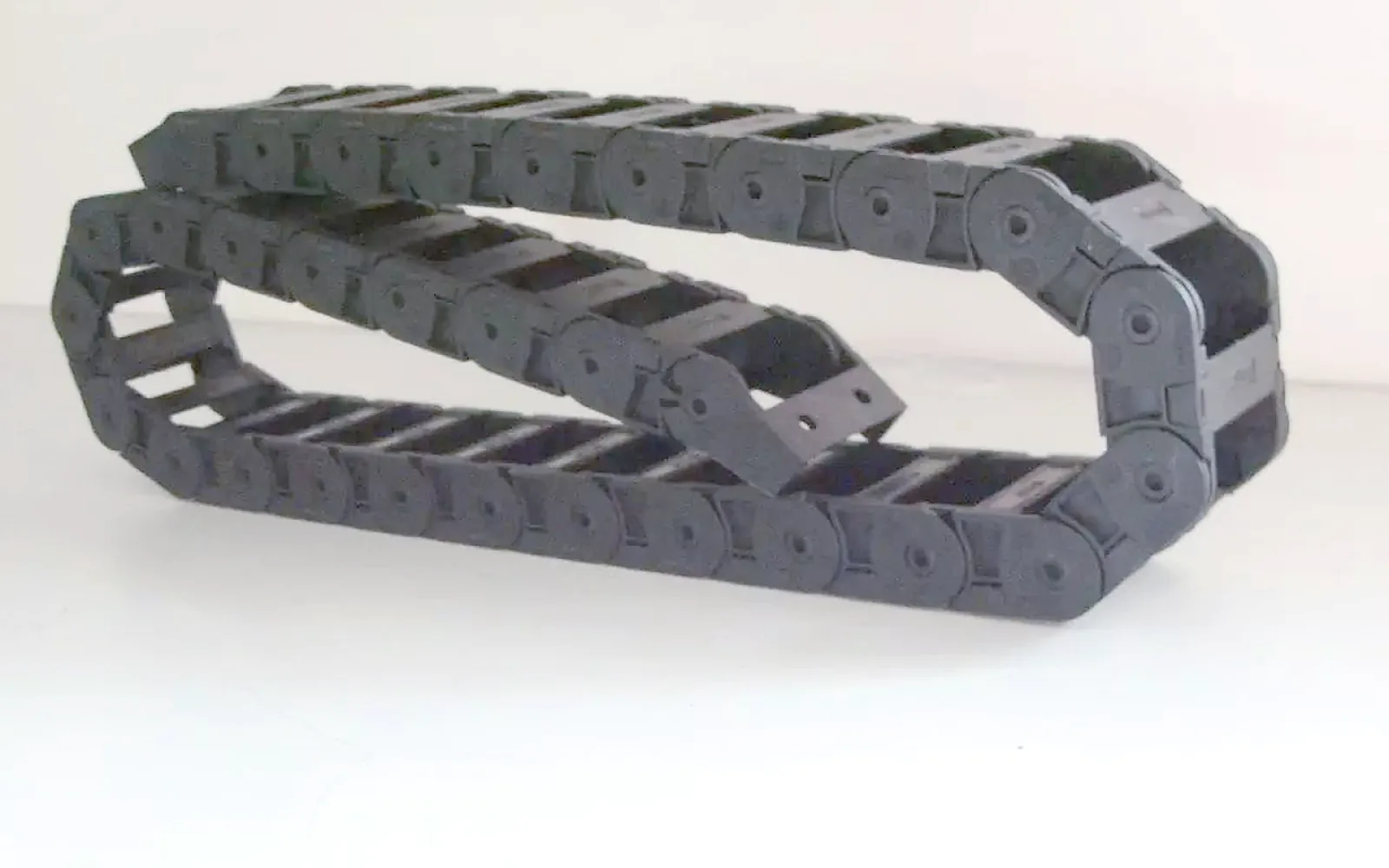
Nylon, TPU and steel answer three conflicting needs: light and cheap, low particle emission, high temperature. Where each belongs, and the order to select in.
"Do you have a better material?" It is one of the most common questions at the selection stage, and one of the hardest to answer in a single sentence.
The difficulty is that there is no "better" cable carrier material, only a "more correct" one. Glass-fibre reinforced engineering nylon, TPU and steel answer three mutually conflicting requirements: light and cheap, low particle emission and low noise, and high temperature with heavy load. Any single material that tries to do all three well becomes too expensive to justify.
This article sets out where each of the three materials actually belongs, which duty each one wins, and which claims to treat with caution when a supplier starts comparing material data sheets.
1. First, drop the idea of a good/better/best ranking
Plenty of enquiry sheets open with "do you have a higher-grade material", implicitly ranking nylon as standard, TPU as mid-range and steel as premium. That ranking does not hold up.
The real relationship is three mutually exclusive routes:
- Light, inexpensive, stiff → glass-fibre reinforced nylon
- Low particle emission, low noise → TPU
- High temperature, impact resistant, heavy load → steel
One example makes it concrete. A cleanroom line runs TPU. If someone then asks "can we add steel side plates so it is stronger", the answer is that it will be stronger, and the particle emission rises with it. The core conflict in a cleanroom is particles, not strength — adding steel simply swaps the problem you set out to solve for a different one.
So the first question is not "which material is better" but "what can this line least tolerate".
2. PA66 + 30% glass-fibre nylon: the default answer for most duties
This is by far the most common material in industrial automation. The glass fibre does more than "make nylon harder": unfilled nylon lacks both stiffness and dimensional stability, and at 30% glass fibre the bending stiffness, creep resistance and heat deflection temperature of the links rise together, which is what keeps a long unsupported span from sagging.
The coverage of the standard CNWSL nylon ranges:
- Micro: inner heights 5 / 6 / 7 / 10 / 15 mm
- Medium: inner heights 18 / 20 / 25 / 30 mm
- Heavy duty: inner heights 45 / 65 / 80 mm
Rated operating temperature is -20 °C to 120 °C, the same across the whole range.
Typical duties: CNC machining centres, injection moulding machines, laser cutting, general automation lines. Its advantages are the widest range, the deepest stock and the lowest unit cost.
Its limits matter just as much:
- Not for prolonged immersion in aggressive media. Acids, alkalis and some coolants attack the nylon matrix, and glass fibre does not improve that.
- Not for high-cleanliness areas. The glass-fibre reinforced links are hard and heavy, so the debris from hinge friction is harder and settles less readily.
- Not for continuous high temperature. Above the rated ceiling you change material, you do not solve it by adding thickness.
When a supplier brings material data sheets to a comparison, watch one thing: read the test standard before you read the number. Tensile properties to ISO 527, Charpy impact to ISO 179, heat deflection temperature to ISO 75 — the same nominal property measured to different standards is not directly comparable. A sheet that gives conclusions without citing standards is background reading only.
3. TPU: the premium you pay for low emission and low noise
TPU (thermoplastic polyurethane) is not used in cable carriers to make them stronger. It is used so that less debris comes off in friction, and less noise comes out.
One point first: the rated temperature window of our standard nylon carriers and of our TPU carriers is the same, -20 °C to 120 °C. So temperature is not the reason to choose TPU. There are exactly two real reasons:
- A different emission mechanism. Nylon gets its hardness from glass fibre, and hard-on-hard friction produces harder, heavier debris. TPU is more elastic, spreads stress across a larger contact area, and releases fewer, softer particles that are also easier for airflow to carry away.
- A different impact noise. The damping behaviour of TPU itself flattens the high-frequency noise of link-on-link impact.
Every CNWSL cleanroom carrier in the WWC series is TPU, covering five inner heights:
| Model | Inner height | Inner width | Available bend radii |
|---|---|---|---|
| WWC15 | 15 mm | 25 mm | R40 / R50 / R60 / R70 |
| WWC18 | 18 mm | 32 mm | R40 / R50 / R60 / R70 |
| WWC22 | 22 mm | 40 mm | R40 / R50 / R60 / R70 |
| WWC28 | 28 mm | 65 mm | R40 / R60 / R70 / R90 |
| WWC35 | 35 mm | 65 mm | R60 / R70 / R90 |
Typical applications: semiconductor equipment, flat panel lines, pharmaceutical cleanrooms, precision optics. In these places the material is judged on cleanliness class, not on strength. ISO 14644-1 classifies cleanrooms as ISO Class 1 to 9 by airborne particle concentration per unit volume; the older US standard FED-STD-209E used Class 1 to 100000, and ISO Class 5 corresponds approximately to the old Class 100.
Break the phrase "meets Class 100 or better" into three questions: which standard does the plant actually apply, is acceptance based on particle counter data or on the supplier's own statement, and is it met at rest or while running. The count while running is always higher than at rest, and that is the point most easily glossed over.
Two more things are routinely overlooked:
- Media compatibility. A cleanroom wipes with alcohol and uses cleaning agents daily. The effect of each medium on TPU has to be confirmed individually; do not assume "TPU resists everything".
- Flammability and substance restrictions. In electronics and panel lines the flammability rating is normally declared to UL 94, and access to the EU market also requires compliance with the substance restrictions of RoHS and REACH. These are material-level compliance items and are separate from the structural design of the carrier.
4. Steel carriers: the third option, for extreme duties
A steel carrier is not a "reinforced nylon". It is a different technical route, and it answers questions that neither nylon nor TPU can:
- High temperature. Near furnaces, casting and welding, ambient temperature sits above the working range of engineering plastics for long periods.
- Heavy load and long travel. Very long unsupported spans, or thick power cables and hydraulic hoses in the cavity, exceed the stiffness of a plastic link.
- Impact and foreign objects. Welding spatter, metal chips and mechanical knocks will simply break a plastic link.
- Open flame and fire requirements. Some metallurgical and marine applications impose mandatory material rules.
The cost is equally clear: high self-weight, high noise, usually requires lubrication, corrosion risk, and a high unit cost. It also does not solve particle emission — the opposite, in fact: steel-on-steel friction is a definite particle source, which is why a steel carrier has no place in a cleanroom.
One point of transparency: steel carriers are a project-based route and are not part of the standard catalogue on this site. Inner height, inner width, bend radius and link plate width are all confirmed per project. Anything involving tooling and scheduling has to be discussed up front, so do not commit to "in stock" at the quotation stage.
5. The three materials side by side
| Dimension | PA66 + 30% GF nylon | TPU | Steel |
|---|---|---|---|
| Representative range | Micro / medium / heavy / silent | Cleanroom WWC | Project-based |
| Inner height range | 5 to 80 mm | 15 to 35 mm | Confirmed per project |
| Rated temperature | -20 °C to 120 °C | -20 °C to 120 °C | Confirmed for high-temp duty |
| Self-weight | Light | Light | Heavy |
| Particle emission | Medium | Low | High |
| Noise | Medium (silent ranges low) | Low | High |
| Impact resistance | Medium | Medium | High |
| Maintenance | Lubrication-free | Lubrication-free | Usually lubricated |
| Main use | General industrial automation | Cleanroom, panel, pharma | Metallurgy, casting, heavy load, open flame |
6. Selection order: environment first, then material, then dimensions
Material is only the second layer. Get the order wrong and everything downstream is wrong too:
- Fix the environment constraints. Temperature ceiling, presence of aggressive media, cleanliness class, whether there is open flame or welding spatter, and whether people physically intervene near the carrier. Once this is settled, usually only one or two materials remain.
- Then pick the material. Use the table above, not the price list.
- Finally size it. Inner width from the total cable cross-section (fill ratio at or below 60% for normal duty, and within 50% for high-speed duty); bend radius derived from the tightest minimum bend radius among the cables; stroke and mounting arrangement decide whether a guide trough or support rollers are needed.
You can run step 3 with your own numbers through the selection calculation flow. Full dimension tables for each range are on the product centre, for example the cleanroom carrier range and specifically WWC15. Material and compliance documents are on the downloads page.
Also, where the carrier sits in a position that affects personnel safety — for example if it occupies part of a safety distance — material and structure should be decided as part of the machine's overall risk assessment, following the principles of ISO 12100 (machinery safety, general design principles), rather than from service life alone.
7. FAQ
Is TPU always more expensive than nylon?
On unit cost, usually yes. But judge cost on the total: the value of TPU is that it brings the cleanroom's particle count into specification. If that fails, the whole line fails acceptance, and the material saving means nothing.
Can I get away with a nylon carrier in a cleanroom?
It depends on the class and on how acceptance is done. If the customer only asks that it "looks clean", nylon may pass. If acceptance relies on particle counter data, nylon generally will not. That judgement cannot be made on feeling — it has to rest on a class requirement written into the technical agreement and on measured data.
Can I mix the three materials?
Across different stations on one line, yes. Within a single carrier, no. Mixing makes load, wear and noise behaviour inconsistent, and it is easy to order the wrong spare later.
What is the lead time for a steel carrier?
Made to project. Anything with tooling and scheduling must be confirmed separately; a standard quotation process cannot give you an accurate figure.
Which management system certifications do you hold?
IATF16949 is held. ISO14001 is still being confirmed. If the project involves automotive customers or export certification requirements, please verify the current status with sales before ordering rather than assuming it.
Can we audit the factory?
Yes. Production is in Yueqing, Zhejiang, and factory audits and sampling are arranged there, with the production lines and moulds available on site. Changzhou is our sales office for day-to-day contact, not a plant.
Conclusion
Choosing a material is not about picking the "best" one. It is about identifying the single thing the duty can least tolerate. If that is particle emission, choose TPU. If it is high temperature and heavy load, choose steel. For most remaining cases, glass-fibre reinforced nylon is the most economical answer.
If you are unsure, send us the actual duty and run it through the selection flow — that is faster than debating material names. You can also contact us directly.