European-standard dust-proof carrier selection: matching inner width and bend radius
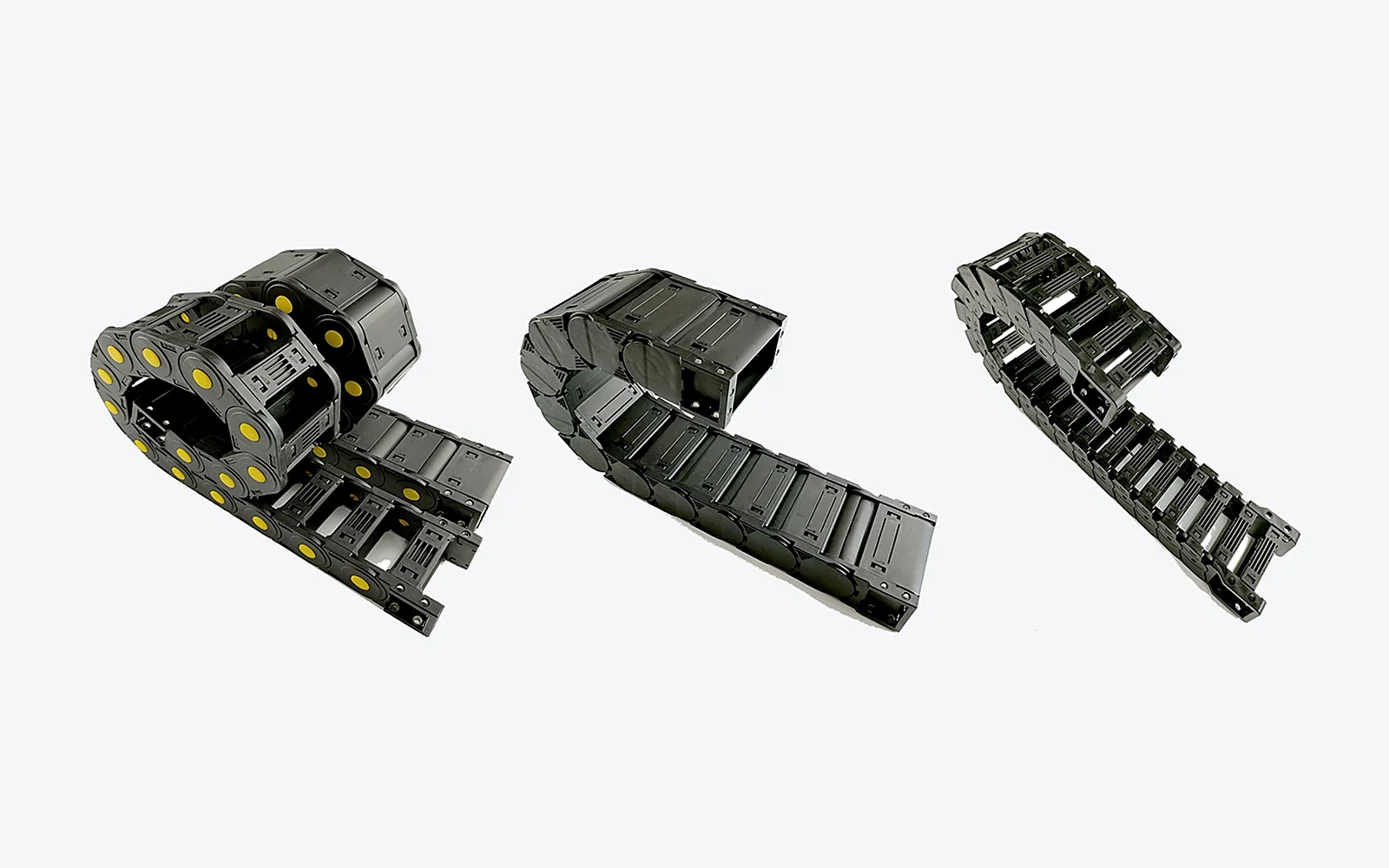
Replacing an imported dust-proof carrier comes down to four comparisons - dimensions fit, load is adequate, life is verifiable, interfaces are adaptable. Includes a five-step acceptance check.
The word "European-standard" turns up on quotation requests more often than any technical parameter. Ask what standard, and eight out of ten customers cannot name one. What they actually mean is: "replace the imported carrier we run now without causing problems."
So this article skips the standards and covers the replacement: four comparisons that decide whether a substitution holds — dimensions, load, life, interfaces. If one of the four does not line up, the substitution is not viable.
What "European-standard dust-proof carrier" really means
Strictly speaking, there is no mandatory standard called "European carrier". In the trade it usually means three characteristics together:
- Fully enclosed or high-coverage design — covers keep chips, dust and coolant off the cables
- High fill density — more cables per unit of inner width, so the assembly is more compact at the same cable count
- Long-life claims — imported brands usually publish cycle counts with duty-specific curves
Those three together are what customers mean. It is a design orientation, not a certificate.
That matters: the evaluation is about whether those three characteristics are equivalent in your duty, not about which datasheet has more rows.
Comparison 1: dimensions
If the dimensions are wrong, nothing else matters. The numbers to match are not "roughly similar inner height and width" but four specific ones:
| Item | How to measure | Common trap |
|---|---|---|
| Inner height | Calliper the clear cavity height | Measuring outer height, then finding the cables will not fit |
| Inner width | Clear cavity width | Ignoring cover thickness, so usable width is narrower |
| Pitch | Centre-to-centre distance between adjacent pins | Different pitch means the chain length does not match |
| Overall height | Total height once assembled | Not enough room inside the enclosure, chain rubs the guard |
Pitch is the most overlooked. Over the same one-metre mounting length, a 30 mm pitch and a 46 mm pitch differ by a dozen links, and the radius of the bend path changes with it. Swap a chain comparing only height and width, and the return bend at the end of stroke lands somewhere else and scrapes the guard.
What to do: cut one link out of the old chain and measure inner height, inner width, pitch and overall height, then photograph the bend section so the R value can be back-calculated. Those four numbers are far more reliable than saying "same as model X".
Comparison 2: load
Load is not "how many cables fit". It is three separate conditions.
1. Fill ratio. Total cable cross-section should stay under 60 percent of the cavity area. Imported chains often run near 50 percent, because that is the condition their life figures were measured at. Fill to 60 percent and demand the same life, and it does not hold.
Calculate each cable by outer diameter (not conductor cross-section), sum, multiply by a 1.1-1.2 layout factor, divide by 0.6 for the minimum cavity area, then divide by inner height for minimum inner width. The full derivation is in the inner-width article.
2. Cable weight. The chain may carry the load; the cables may not. Heavy power cables at two or three kilograms per metre are common, and span capability is rated on chain plus cable weight together. Reading only the chain curve overestimates it.
3. Auxiliary loads. Air and hydraulic hoses have internal pressure. Pressurised hoses stiffen and spring back, so the side load through the bend is higher than with an empty hose. Where high-pressure lines are carried, take one step down on unsupported length.
Comparison 3: life
Life is the easiest item to blur and the most expensive to get wrong.
The short version: a published cycle count without test conditions is meaningless. Four questions have to be answered:
- What travel length — one metre and five metres load the chain completely differently
- What speed and acceleration — acceleration hurts more than speed
- What fill ratio and cable configuration — an empty chain proves nothing about a full one
- What failure criterion — link crack, pin wear limit, or cable jacket damage
Change any of those four and the quoted cycle count can shift by a factor of three. So do not compare "numbers". Compare whether the supplier will stand behind performance in your duty.
A workable validation path: take a small sample, run it on the actual machine for one maintenance interval, then inspect three things — pin clearance growth, side-plate wear depth, and scoring on the link bore. If all three stay within reasonable limits, discuss the full batch.
Comparison 4: interfaces
If the interfaces do not match, the first three comparisons are wasted. Check:
- Mounting holes at fixed and moving ends — spacing, diameter, whether an adapter plate is needed
- End fitting type — bolted, clipped, or clamped
- Cable entry direction — horizontal or vertical, and whether sealing is required
Most replacement projects spend more time on end fittings than on the chain. If the old fitting is a one-piece crimped assembly, it is effectively scrap once removed, and the new chain needs new end plates. Put that cost into the quote early.
What can be replaced, and what should not
Being direct about this.
Reasonable to replace: normal temperature, normal speed, horizontal reciprocation under three metres, fill under control, interfaces adaptable. The cost advantage is real in this range.
Not advisable:
- Above about 4 m/s or very high acceleration, where link dynamics are the accumulated result of long development — revalidation costs more than the saving
- Front-end cleanroom tools already inside a customer certification system, where replacement goes through a change process no supplier controls
- Lines with an existing demonstrated life figure, where a swap simply transfers risk, and someone has to price it
The acceptance checklist: five things after delivery
- Measure inner height, width and pitch on three random links against the drawing
- Run the empty chain by hand through one cycle — listen for noise, feel for binding
- Run it on the machine unloaded and watch the bend section for interference with guards or rails
- Run one loaded shift, then check link temperature and pin-area heat
- Record the baseline pin clearance for later wear comparison
Do those five before signing. It is cheaper than an argument three months later.
Summary
Replacing a European-standard carrier comes down to four comparisons: dimensions fit, load is adequate, life is verifiable, interfaces are adaptable. All four pass, the substitution holds. Any one left vague is a risk you have taken on yourself.
For a specific evaluation, send the four old-chain dimensions, the cable list (outer diameter and quantity), travel and speed. See the five-step selection guide, price ranges, or contact us directly.