Cleanroom cable carrier selection: particle emission, bend radius and life verification
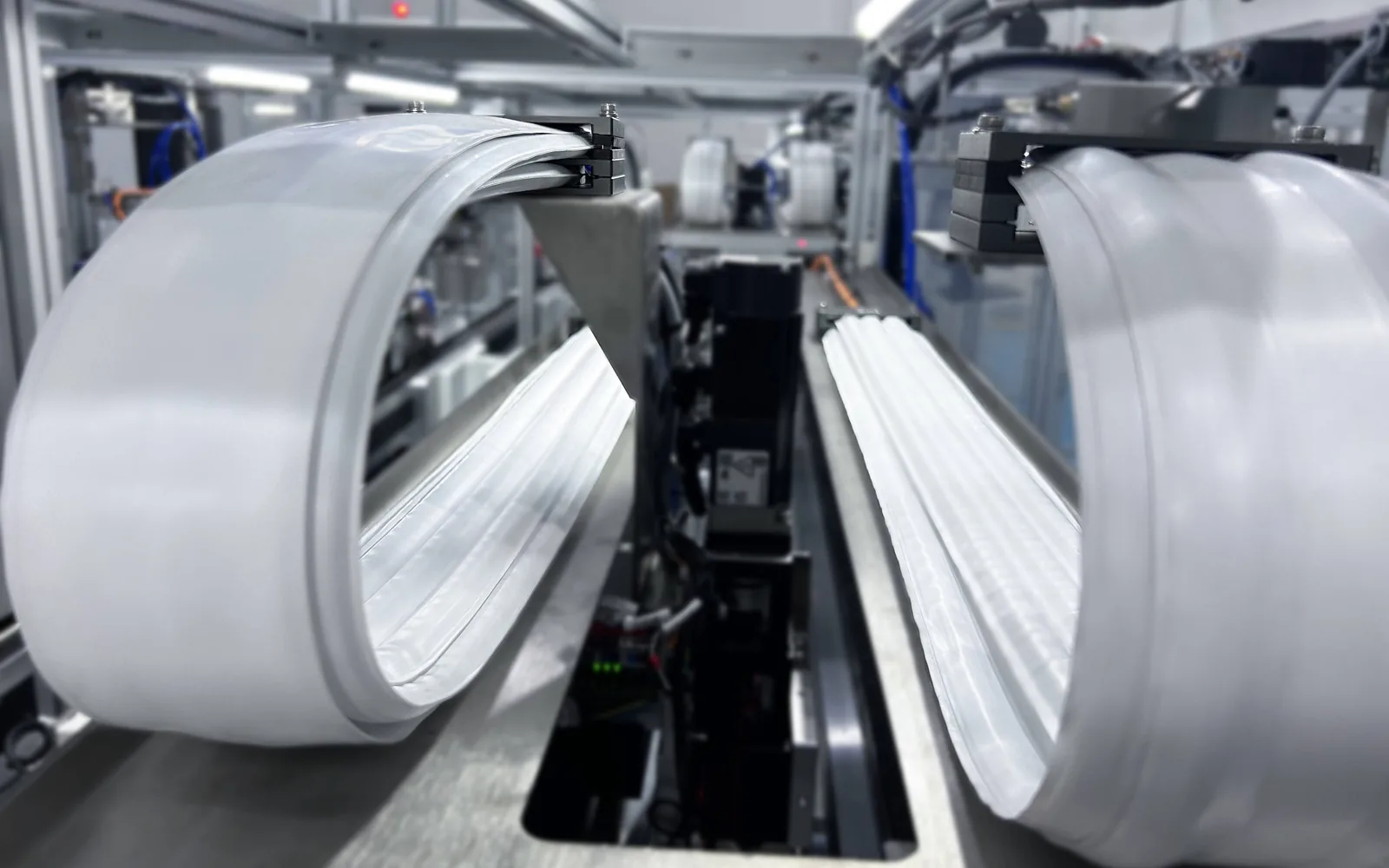
A cleanroom carrier is not an upgraded nylon chain: switching to TPU changes particle emission, temperature window and noise. Here is the WWC selection order, the three test reports to request, and four installation traps.
A cleanroom cable carrier is not a nylon chain with a cover added. Inside a cleanroom it does two jobs at once: it carries the cables, and it does not release particles into the environment. Most selection mistakes come from looking only at the first one.
1. Material first: cleanroom carriers use TPU, not nylon
A standard nylon cable carrier is made of PA66 with 30% glass fibre, and it relies on stiffness and wear resistance to survive long travel. A cleanroom carrier has a different priority — how much material gets rubbed off — so the mainstream approach is to switch to TPU (thermoplastic polyurethane).
Changing the material has three knock-on effects:
- The wear mechanism changes. Nylon gets its hardness from glass fibre, so the debris from chain-link contact is harder and heavier. TPU is more elastic, spreads the load across the contact surface, and sheds fewer and softer particles.
- The temperature window changes. The CNWSL WWC cleanroom carrier is rated at -20°C to 120°C, which does not match the standard nylon ranges. High-temperature cleanroom duty needs to be calculated separately.
- Noise behaviour changes. The damping properties of TPU naturally reduce impact noise in high-speed reciprocation — one reason ESD-sensitive workshops often pick it up at the same time.
If a customer insists on "making nylon clean", ask about the required cleanliness class first. When the two materials are close, making up the difference with sealing structures usually costs more.
2. Fix the cleanliness class before anything else
The cleanroom class is an input to selection, not a result you verify afterwards. The international standard is ISO 14644-1, which ranks ISO Class 1–9 by particle concentration per unit volume of air; the older US FED-STD-209E used Class 1–100000, and ISO Class 5 corresponds roughly to the old Class 100.
It is worth unpacking the phrase "meets Class 100 and above":
- Which standard does the site actually work to? Is acceptance based on particle-counter data or on the supplier's declaration?
- Is it at rest or in operation? Particle counts rise noticeably once the machine is running.
- Is the carrier the only particle source, or just one of several?
The CNWSL WWC series is designed for semiconductor, flat-panel and pharmaceutical cleanrooms, with low particle emission and low noise. Which class it actually achieves must be backed by the test report for the specific batch — write that requirement into the technical agreement at the selection stage and the rest gets easier.
3. Four parameters, in this order
3.1 Inner height and inner width: keep the fill ratio under 60%
List every cable that has to run through the carrier — power, signal, air hose and fibre counted separately — total up the cross-sections, then apply a safety factor of about 1.6. The total cable cross-section should generally stay under 60% of the carrier cavity, and lower still for high-speed duty.
Wider is not better. Too much spare room lets the cables shift inside the cavity, which increases both wear and noise.
3.2 Bend radius: work backwards from the cable
The bend radius is decided by the cable, not by the carrier. Take the thickest, stiffest cable in the run (usually the power line or the air hose), look up the manufacturer's minimum bend radius, and apply 1.1×–1.2× margin. That gives the R value the carrier has to offer.
One point that gets confused often: the carrier's R value sets the installation height and the space it occupies. It is not, by itself, a cable life figure.
3.3 Travel and mounting
- Under 2 m travel, horizontal mounting: standard support is enough.
- Long travel or high-speed reciprocation: calculate the self-supporting capacity and sag of the unsupported span, and add a guide trough or support rollers where needed.
- Vertical mounting: evaluate the continuous load the chain's own weight puts on the pins, plus the swing amplitude.
This part is hard to explain in prose — run through the selection calculation flow with your travel, speed and acceleration instead.
3.4 Temperature, media and static
- Temperature: the WWC series is rated -20°C to 120°C. Outside that range, consider a different material.
- Media: coolant, cleaning agents and alcohol wipes are daily reality in a cleanroom. List them and have the supplier confirm compatibility.
- Static: electronics assembly and panel lines often carry ESD requirements. Be clear whether you need "dissipative material" or "conductive grounding" — they are built differently.
4. WWC series at a glance
CNWSL cleanroom carriers currently cover five inner heights, all in TPU, rated -20°C to 120°C:
| Model | Inner height | Inner width | Available bend radii |
|---|---|---|---|
| WWC15 | 15 mm | 25 mm | R40 / R50 / R60 / R70 |
| WWC18 | 18 mm | 32 mm | R40 / R50 / R60 / R70 |
| WWC22 | 22 mm | 40 mm | R40 / R50 / R60 / R70 |
| WWC28 | 28 mm | 65 mm | R40 / R60 / R70 / R90 |
| WWC35 | 35 mm | 65 mm | R60 / R70 / R90 |
These are the standard inner widths. A non-standard width or a non-standard bend radius needs tooling, so confirm the mould and the lead time early — otherwise the project stalls at this step. The full dimension tables are on the cleanroom carrier series page, model by model, for example WWC15.
5. Factory audit and acceptance: which documents to ask for
When you buy a cleanroom carrier, "evidence" is the easiest thing to leave vague. Put the list directly into the technical agreement:
- Low particle emission test report — test method, sampling conditions (loaded or unloaded), particle count results.
- High/low temperature cycling test — confirms the material does not crack or harden at either -20°C or 120°C.
- Fatigue life bench data — cycle count and failure criteria (sudden noise increase, excessive link clearance, breakage).
- Material declarations — TPU grade, halogen content, RoHS status.
For CNWSL, these three reports (particle emission, temperature cycling, fatigue life) are available from the downloads page together with the cleanroom catalogue. Being able to issue a report and being willing to issue it are two different things — send the list at the selection stage; how fast the other side responds is itself a screening test.
6. Four installation traps
- Mounting the carrier downstream in the airflow. Cleanroom airflow is designed deliberately. If carrier debris settles above the product flow, the selection was wasted.
- Reversing the fixed and moving ends. The curved section should sit away from the side that has to stay clean.
- Ignoring cable clamping. Clamp the cables a short distance from each end of the carrier so that bending happens only inside it. Running cables straight in and out cuts life noticeably.
- Accepting on static conditions only. Run it empty, run it loaded, run it continuously for more than 8 hours, and record noise and particle data in all three states.
7. FAQ
Can a domestic cleanroom carrier replace an imported brand?
Whether it can replace one depends on the acceptance criteria, not on the brand. Write the cleanliness class, particle emission limit and life requirement as measurable clauses, and domestic supply chains pass under most standard conditions. Conversely, if the requirement itself is not measurable, any supplier will end up arguing about it.
What are typical lead times?
Stocked standard sizes are the fastest. A non-standard inner width or bend radius requires tooling, and the lead time has to be confirmed separately. CNWSL holds stock in Dongguan, Foshan and Shanghai; ask sales about shipping cadence for standard parts.
Cleanroom carrier or silent carrier?
The two requirements overlap but are not identical. If particles are the core problem, choose the cleanroom carrier (TPU). If noise is the core problem, choose the silent series. If both matter, write both metrics into the agreement and then compare samples.
Can we audit the factory?
Yes. Production is in Yueqing, Zhejiang, and factory audits and sampling are arranged there, with the moulds and production lines available on site.
Do you hold IATF16949?
Yes, IATF16949 is held. One more note: if the project involves automotive customers or export certification, ISO14001 is usually required as well — please confirm the current status with sales before ordering rather than assuming it.
Conclusion
The hard part of cleanroom carrier selection is not the parameters, it is the chain of evidence: a measurable class requirement, traceable particle data, and verifiable installation constraints. Nail those three down at the selection stage and acceptance and mass production get much smoother.
To run the numbers against your actual travel and cable list, start from the cleanroom carrier series or read the selection calculation flow first.