How to cut cable carrier noise at high speed
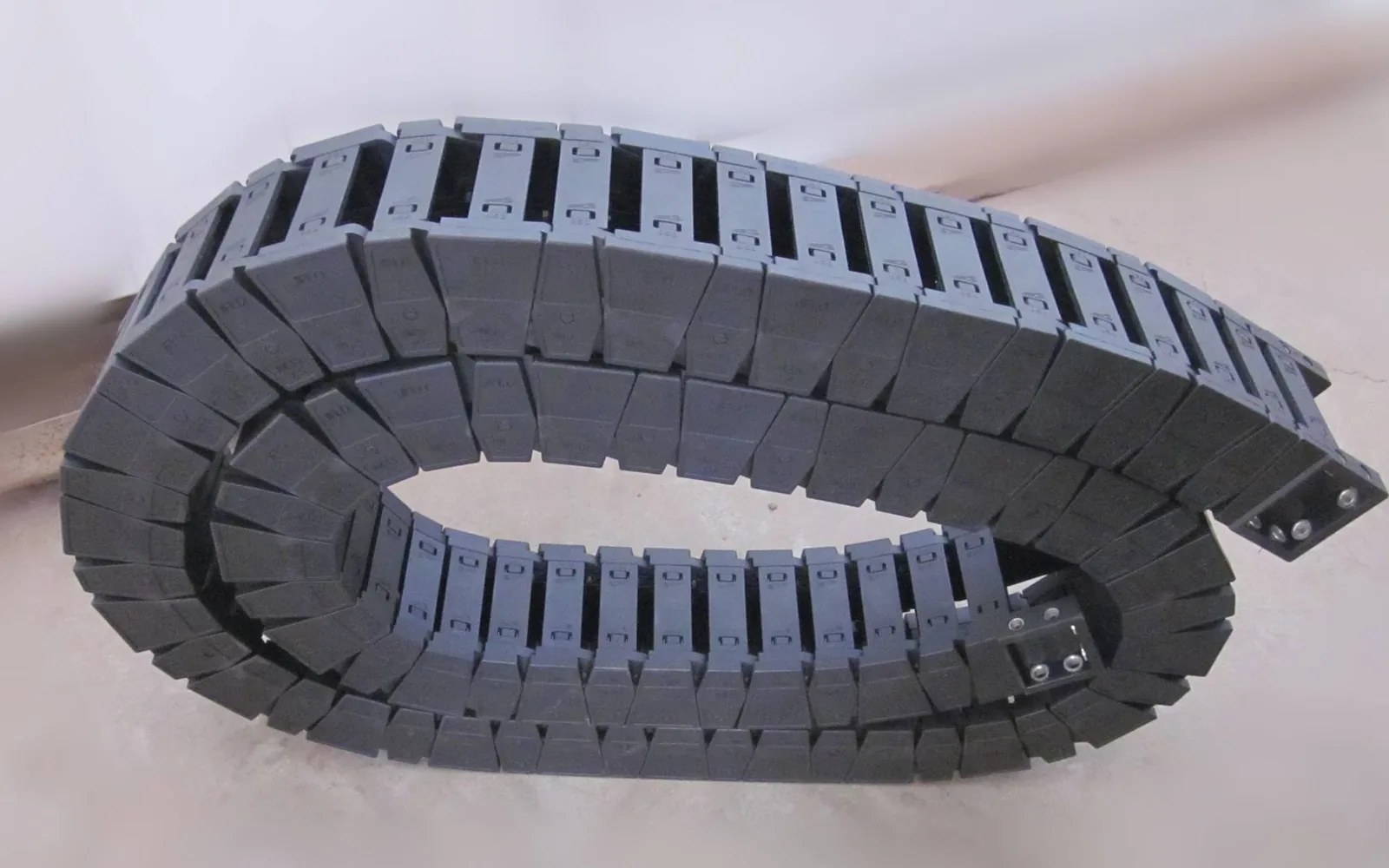
Link impact, hinge friction, cable flutter and resonance drive carrier noise. Five reduction points for high-speed duty, and the method to fix first.
1. Take the noise apart: it is four sources, not one
When a machine starts up and the cable carrier begins to rattle, the first reaction on site is usually "the chain must be poor quality". Break the noise down, though, and at high reciprocating speeds there are at least four independent sources — and each has a different fix:
- Link impact noise: adjacent links compress and rebound as they enter and leave the bend section. This is structural noise, high in frequency and sharp to the ear, and it is the one most often complained about.
- Hinge friction noise: pin and bore sliding against each other on every stroke. It becomes more obvious as speed rises, and it sounds abrasive.
- Cable flutter and slapping: cables with too much freedom inside the channel swing on start and stop and hit each other. Secondary, but easily overlooked.
- Resonance amplification: the carrier's natural frequency lines up with the machine's start/stop rhythm and magnifies all three sources above. The classic symptom is one particular speed being loud while faster or slower is quiet.
Sequence matters: treat the source first (impact, friction), then the secondary source (cable flutter), and only then damping and isolation along the transmission path. Do it the other way round and you spend money without reducing noise.
2. Lever one: hinge geometry, the best value for money
At the same 1 m/s, the difference you hear between a silent carrier and a standard one comes mainly from the hinge, not from the material grade.
The CNWSL silent cable carrier range uses low-friction hinges and an optimised link profile so that links slide through the bend instead of striking it. This single change usually contributes more to the overall noise level than any material substitution — material changes the timbre, geometry changes the sound pressure level.
Three questions to put to any supplier, and an inability to answer any of them is a reason to walk away:
- Is the hinge a sliding fit or a rolling fit?
- Do the links have a limit stop to prevent excessive swing?
- Is there comparative data between the silent and standard version of the same size?
3. Lever two: bring the fill rate down
A higher fill rate packs the cables tighter, increases the contact area, and leaves less working clearance — so cables start slapping each other on start and stop, and noise goes up rather than down.
Common practice for high-speed reciprocating duty is to keep the fill rate at around 60% or below, together with three actions:
- Route cables with very different cross-sections in separate channels, or add separators;
- Put power cables and signal cables on opposite sides;
- Leave sensible working clearance inside the channel — never pull the cables taut.
4. Lever three: go up one bend radius
Bend radius R is the hidden variable in noise. Too small an R means a sharper link angle through the bend, harder impact, and higher bending stress in the cables at the same time.
On the CNWSL silent range the available bend radii step up with inner height, and each inner height normally offers three to five options:
| Series | Inner height | Inner width | Bend radii |
|---|---|---|---|
| Silent 18 | 18mm | 25–50mm | R28 / R38 / R48 / R55 |
| Silent 25 | 25mm | 25–110mm | R55 / R75 / R100 / R125 |
| Silent 30 | 30mm | 25–110mm | R55 / R75 / R100 / R125 |
| Silent 35 | 35mm | 25–125mm | R75 / R100 / R125 / R150 |
| Silent 40 | 40mm | 50–125mm | R75 / R100 / R150 |
| Silent 45 | 45mm | 50–125mm | R75 / R100 / R125 / R150 / R200 |
Where installation space allows, take the next size up: the link angle through the bend becomes gentler and both noise and cable stress fall. The price is more installation height and more travel envelope, so settle that at the design stage.
5. Lever four: fixed end, floating end and support method
On long travels at high speed the carrier whips on the return stroke. Three measures:
- Once travel exceeds the manufacturer's unsupported length table, switch to a gliding arrangement, or add support rollers and guide channels;
- Leave slack in the wiring at the fixed and moving ends — do not stretch it straight;
- Add cushioning at both ends so links do not strike hard at the limit positions.
This section is routinely ignored, yet a good share of on-site noise complaints originate here rather than in the carrier itself.
6. Lever five: cable choice and layout
- Prefer high-flex drag-chain cables. A stiffer cable hits the link harder on start and stop, and both noise and service life suffer.
- Multi-core cables with a stiff braid or shield should sit close to the centre of the channel.
- Let cables take their natural bend. Do not twist them and do not stack them across each other.
- With few cables, do not loop them around the channel — that simply creates a flutter source.
7. Silent range specification table
The CNWSL silent carrier range covers inner heights from 18 to 45mm, is made of glass-fibre reinforced nylon, and is rated for -20℃ to 120℃:
| Series | Inner height | Inner width | Models | Bend radii |
|---|---|---|---|---|
| Silent 18 | 18mm | 25–50mm | WSL01J | R28 / R38 / R48 / R55 |
| Silent 25 | 25mm | 25–110mm | WSL02J, WSL02JL, WSL03J | R55 / R75 / R100 / R125 |
| Silent 30 | 30mm | 25–110mm | WSL04J, WSL05J | R55 / R75 / R100 / R125 |
| Silent 35 | 35mm | 25–125mm | WSL06J, WSL06J2, WSL07J | R75 / R100 / R125 / R150 |
| Silent 40 | 40mm | 50–125mm | WSL08J, WSL09J | R75 / R100 / R150 |
| Silent 45 | 45mm | 50–125mm | WSL10J, WSL11J | R75 / R100 / R125 / R150 / R200 |
Drawings and detailed specifications are available on the downloads page.
8. How to accept a noise claim: agree the method first, the number second
Noise has no absolute value — only a value measured under stated conditions. Put the microphone at 1 m and at 3 m on the same machine and the results differ substantially; skip the background correction and two data sets are simply not comparable.
So agree three things before acceptance:
- Measurement positions and distances: where the work station and bystander positions are, how far from the source, how high off the floor.
- Background noise and correction: measure background with the machine stopped, and apply the correction when the margin is insufficient.
- Duty definition: speed, acceleration, travel, load and cable configuration must all be stated. Miss one and the comparison is void.
The widely used method for emission sound pressure level at a work station and other specified positions is ISO 11202:2010. If what you need is sound power level — for comparing machines rather than for listening at a workstation — the engineering method is ISO 3744:2025.
Cleanroom applications add one more constraint: noise reduction must not be bought with extra particle emission. Cleanliness is classified under ISO 14644-1:2015, and where low noise and low emission are both required, see our cleanroom cable carrier selection guide.
9. Frequently asked questions
If I slow the machine down, does the noise go away? Not entirely. Slowing down does reduce impact energy, but if the dominant source is resonance or cable flutter you have simply moved it to another frequency band. Identify the source first, then decide between slowing down and changing the geometry.
Can silent and standard carriers be mixed on one machine? Yes, but watch pitch and interface. Mixing series on one machine leaves the joint with inconsistent stiffness, and at high speed that joint easily becomes a new noise source. Unify where you can.
Does lower noise mean shorter life? Usually the opposite. Impact and friction are both noise sources and wear sources, so the geometry changes that suppress them generally extend life. What really shortens life is shrinking the bend radius to save space — which is why R should only ever be taken larger, never smaller.
The plant is too loud to measure accurately. What then? Locate the source first (shut down sections, isolate step by step), then run an A/B comparison under identical duty. When absolute values are unreliable, the relative difference is still meaningful — and closer to the truth than arguing about decibels.
Conclusion
Cutting cable carrier noise is not about buying a "better" material. It is five things done in order of source: change the hinge geometry, bring the fill rate down, increase the bend radius, deal with the end fittings and support, and tidy up the cable layout. The first two set the floor; the last three decide whether the result is merely serviceable or genuinely quiet.
For a calculation down to the model and bend radius, walk through our five-step selection method, or contact us with your duty data. CNWSL manufactures in Yueqing, Zhejiang, and factory audits and sample testing are arranged there — the more specific the duty data, the closer the proposal gets to your machine.