What sits behind a 36-month warranty: how life testing actually works
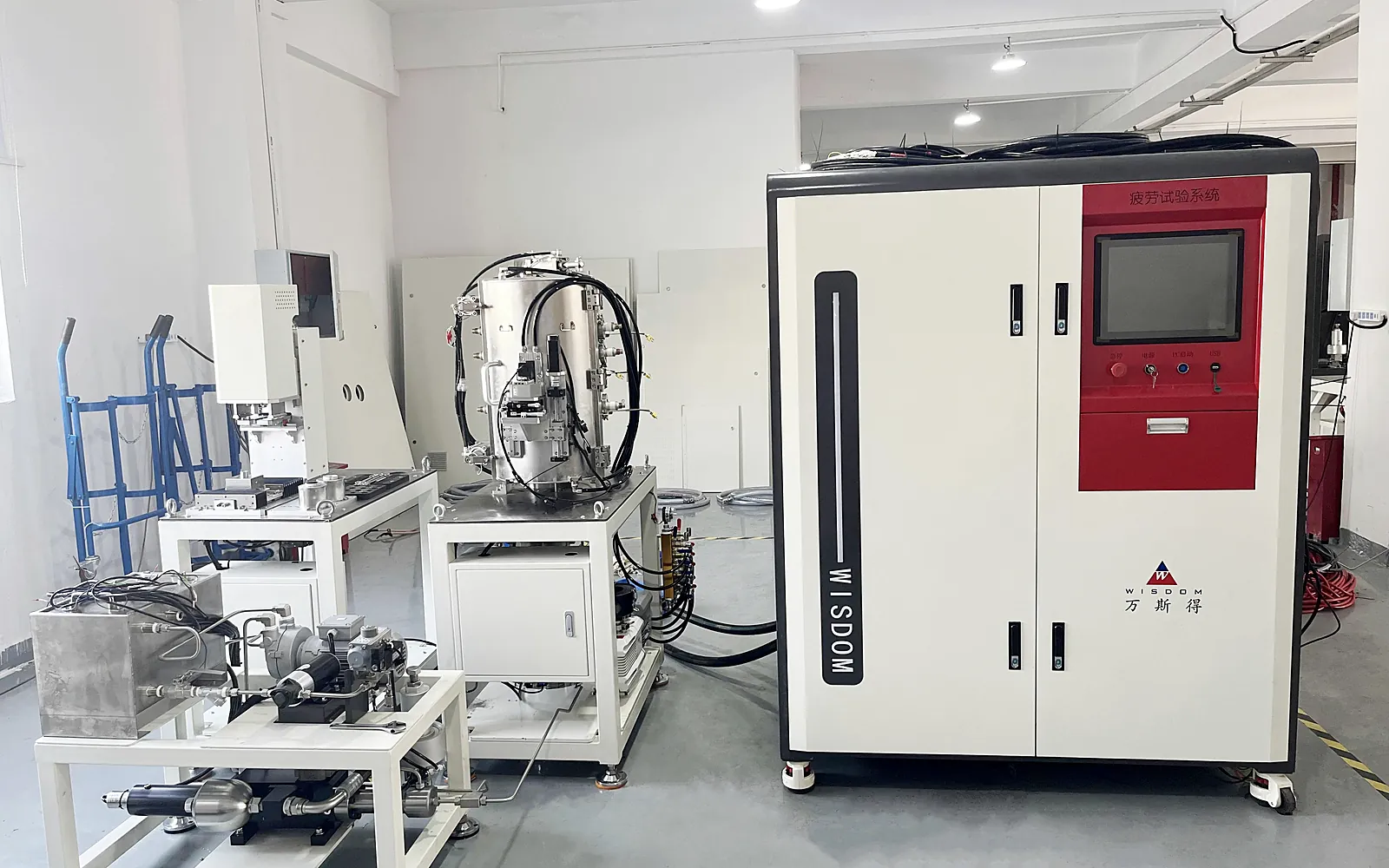
A 36-month warranty rests on three things: reproducible bench data, a defined failure criterion, and terms that state the boundaries. Also how a buyer verifies a supplier's claims.
A 36-month warranty is easy to print on a quotation and hard to put in a contract. What backs it is not a promise but three things: reproducible bench data, an explicit failure criterion, and terms that state the boundaries.
This article explains how we validate life, and how a buyer can check what a supplier claims.
The three hidden preconditions in any warranty
First, a cold shower: a warranty without preconditions is not a warranty.
Look for these three before anything else:
- Fill ratio ceiling. Coverage usually applies only within an agreed fill ratio, say 60 percent. Fill to 80 percent and the clause is void
- Duty envelope. Temperature, speed, acceleration, travel, corrosive media — outside the envelope, no coverage
- Installation compliance. Fixed-end position, support spacing, cable layout — installed incorrectly, no coverage
A warranty that states all three is real. One that says "36 months" and nothing else leaves interpretation to the supplier.
Our approach is to print those three conditions into the warranty text, where the customer can read them before signing. It is not the most flattering look, but it removes most disputes later.
Bench testing: what gets recorded
Life testing is not "run it until it breaks". It is recording a degradation curve under controlled conditions.
A bench has a drive end reciprocating over an adjustable stroke, a load fixture, and the bend radius fixed at the target R. Four measurements are logged at fixed intervals:
| Measurement | Method | What it tells you |
|---|---|---|
| Cycle count | Counter | The baseline, not the conclusion |
| Pin clearance growth | Feeler gauge or displacement sensor | Wear rate, the most sensitive indicator |
| Link temperature | Thermocouple on the link bore | Friction heating; a rise predicts failure |
| Noise drift | Sound level meter at fixed distance | Direct proxy for impact-face wear |
Why pin clearance: link fracture is sudden, but clearance growth is gradual. Once clearance passes a threshold the running path starts to drift, then the chain runs off-centre, then it binds. The clearance curve predicts better than a breakage test.
Fix the noise method: distance, background level and operating point all fixed, otherwise the numbers are not comparable. That is also why different suppliers quote different decibel reductions — they are not measuring the same thing.
Accelerated ageing: three environments, separately
Bench testing covers mechanical life. Environmental ageing runs separately:
1. Dust. The chain runs in a dust chamber with standard dust blown continuously, simulating foundry, woodworking and cement duty. What matters is whether dust reaches the sliding faces and packs into the pin area as an abrasive.
2. Coolant. Spray and immersion cycles with cutting fluid, simulating machine interiors. Watch swelling, surface tackiness and joint loosening. Emulsion is harsher than neat oil and has to be tested separately.
3. Thermal cycling. Alternating high and low temperature, watching cold-start brittleness and hot softening or creep. Cycling is harder on the material than constant temperature — repeated expansion builds internal stress.
After all three, the chain goes back on the bench. That gives the combined environmental and mechanical picture. Bench-only data overstates life in a real shop.
Failure criteria: what counts as end of life
This is the item most often left vague. There are four common criteria, in rising severity:
- Functional failure — binding, fracture, will not run. The floor, but too late
- Path deviation — bend section leaves the design path beyond tolerance. Repairable, but it scrapes guards
- Wear threshold — pin clearance or side-plate wear beyond a set value. The basis for preventive replacement
- Performance degradation — noise rise or abnormal link temperature. Early warning
We use the third: life ends when pin clearance reaches the threshold, not when the chain breaks. The reason is that fracture is a catastrophic failure mode — it takes the cables with it, and repair costs far more than an early replacement.
When reading a supplier's life figure, ask directly: "which criterion defines end of life?" An answer of "we run it until it breaks" means the figure is optimistic.
Field correlation: bench data has to land
A bench is idealised; a shop floor is composite. So field sampling runs alongside.
The method is to pick representative lines across industries and duty profiles, revisit them on a fixed interval with customer consent, and record actual replacement intervals and failure modes. That data feeds back into bench parameters — when actual life is clearly shorter than predicted for a duty class, the bench is missing a factor, usually dust or temperature rise.
Our field sample is weighted toward injection moulding, where our own production runs 70-plus machines. Hot, oily, continuous duty is an effective accelerated environment.
Writing terms that hold up
A workable warranty has four parts.
What is covered: failures from material or manufacturing defects, replaced free of charge.
What is not (state it explicitly):
- Operation outside the agreed fill ratio, temperature, speed or travel
- Installation not to specification — wrong fixed-end position, excessive support spacing, incorrect cable tying
- Impact damage, third-party modification, missed maintenance
- Failures from mixing with unapproved cables or fittings
How it is judged: an agreed method — visual inspection, dimensional measurement, third-party testing where needed — so both sides are not arguing from different evidence.
How it is remedied: replacement, refund, or pro-rata credit, plus a response time.
With all four, a warranty is an executable clause rather than marketing language.
How a buyer can verify a supplier
You do not have to wait for a failure. Four things before signing:
- Ask for test reports and check they state conditions — stroke, speed, fill, temperature. A report without conditions is not evidence
- Ask for the failure criterion — clearance threshold, or run-until-break
- Ask for field references in your industry. Many customers prefer not to be contacted, but those who agree usually tell you something
- Run a pilot batch on a real machine for one maintenance interval, then measure pin clearance
The fourth is the most convincing. One batch and one interval beats any report.
Summary
Behind a 36-month warranty sit three things: bench data under controlled conditions, a defined failure criterion, and terms that state the boundaries. Remove any one and the warranty becomes a pleasant sentence.
For the test methodology, ask us for a test summary. To go through warranty boundaries item by item, send your duty and we will say what can and cannot be covered.
Related: material comparison, speed and acceleration limits, five-step selection.