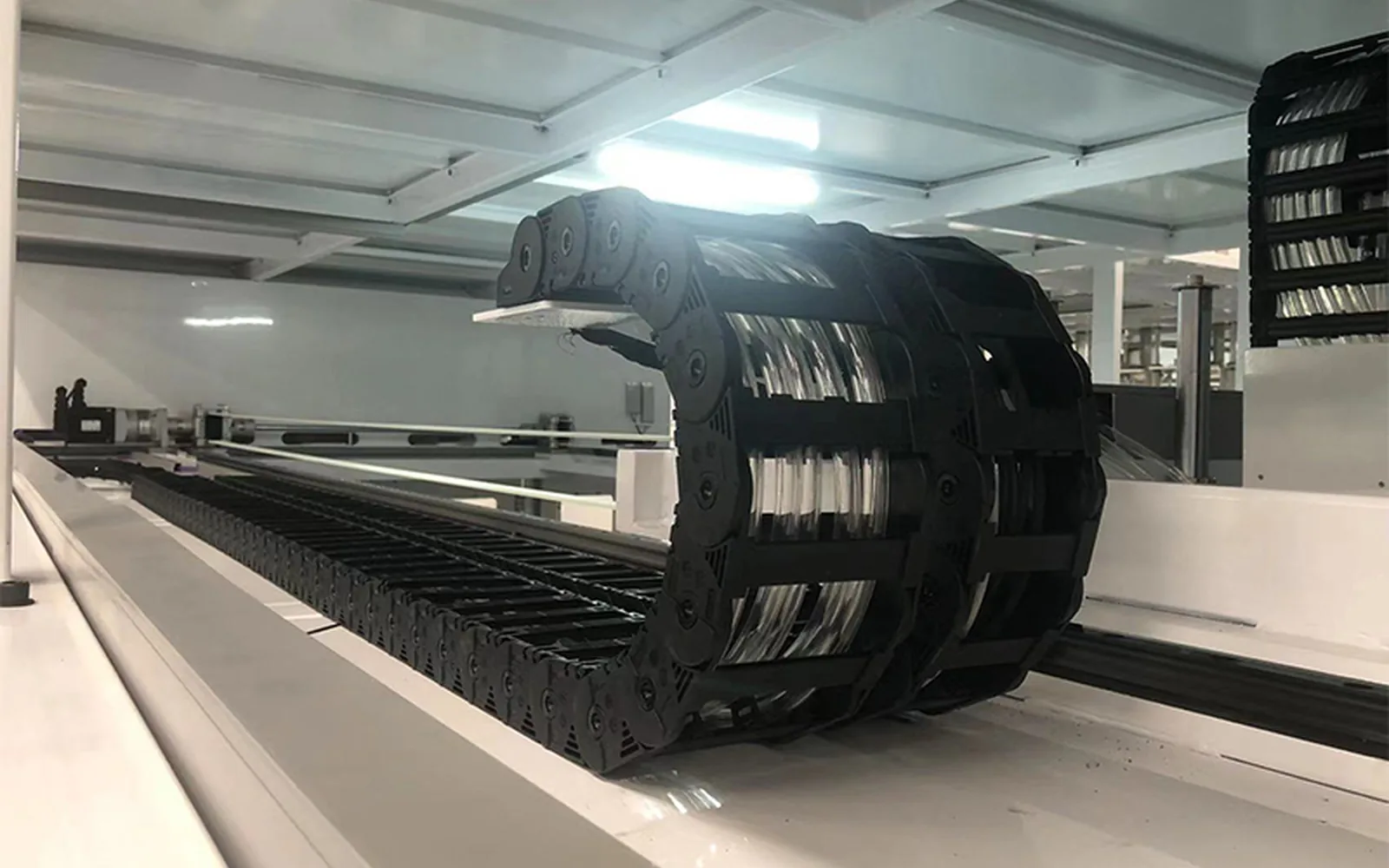
What a cleanroom carrier is actually judged on
Four things decide whether a carrier belongs in a cleanroom. Only one of them usually appears on a datasheet.
- Particle emission at the sliding surfaces — Pin and side-plate contact is where debris is generated. Enclosed covers keep chips out, but they also trap whatever the chain itself produces, so material choice matters more than enclosure.
- Wear mode of the material — Glass-filled nylon is strong and stiff, and when it wears it releases hard filler particles. TPU wears more slowly and more benignly, which is why the cleanroom series is TPU.
- Noise and vibration — In a quiet cleanroom a chain that rattles is audible, and vibration is also a wear accelerant. Silent-link geometry reduces both.
- Cleanability — A carrier that cannot be wiped down, or that has open pockets holding residue, will fail an audit even if it measures clean on day one.
Where our numbers come from
Report ZH 2608-1800, issued 2026-09-30 by Fraunhofer IPA and valid to 2031-09-30, tests the particle emission of one carrier assembly against ISO 14644-14, with classification to ISO 14644-1.
Test conditions were 22 °C ± 0.5 °C and 45 % ± 5 % relative humidity. Three belt speeds were run — vf 0.5, 1.0 and 2.0 m/s, corresponding to ae 1.0, 2.0 and 4.0 m/s² — and all three returned ISO Class 1, with an overall result of Class 1. The report can be checked independently at tested-device.com using the report number.
What we build
The cleanroom series runs from 15 to 35 mm inner height in five steps: WWC15, WWC18, WWC22, WWC28 and WWC35. Bodies are TPU; covers can be enclosed or crossbar. Standard sizes ship in one to three days, and MOQ is one piece, because qualification samples rarely need a container.
What the test does not cover
Being specific here saves both of us a meeting.
The certificate covers one model in one colour, in the condition it was tested. It is a statement about the particle emission of that component — not a certification of your tool, not a guarantee that your line holds its class, and not transferable to other sizes in the range.
It also stops at 2.0 m/s and 4.0 m/s². Above that, the chain is outside the tested envelope and we will say so rather than quote the Class 1 figure anyway. Where ESD is required, the anti-static variant is a different material compound and is not covered by this report.
Where cleanroom installations go wrong
- Overfilling the cavity — Above roughly 60 % fill the cables rub each other, not just the chain, and the debris source becomes the cable jacket. Many field failures blamed on the carrier are actually cable-to-cable abrasion.
- Mismatched jacket material — A standard PVC jacket running against TPU wears quickly. Specify a jacket that suits continuous flex and low abrasion instead of whatever was on the shelf.
- Mounting flatness — A few tenths of misalignment across a long travel puts side load on the pins and shortens life in a way that looks like a material problem but is not.
- Compressed cable ties — Ties tight enough to deform the jacket create a wear point at the fixed end. Strain relief should hold position, not clamp hard.
Specification at a glance
| Series | WWC15 / WWC18 / WWC22 / WWC28 / WWC35 |
|---|---|
| Inner height | 15–35 mm |
| Body material | TPU (anti-static compound available) |
| Tested model | WWC.28.65, white only |
| Classification | ISO Class 1 at vf 0.5 / 1.0 / 2.0 m/s |
| Report | Fraunhofer IPA ZH 2608-1800, valid to 2031-09-30 |
| Lead time | Standard sizes 1–3 days; MOQ 1 |
Figures are the range across the series, not a guaranteed value for every size. Confirm the model against your duty before ordering.
Questions buyers ask at this stage
Is the whole cleanroom range ISO Class 1 certified?+
No. The Fraunhofer IPA report covers WWC.28.65 in white only. Other sizes share the same TPU construction and design intent, but they have not been tested to ISO 14644-14, and we do not present them as certified.
Can you supply the report for a customer qualification package?+
Yes. The PDF is available on request and can be verified at tested-device.com with the report number. It states the model, colour and test conditions — we send it unedited, because a truncated version causes more trouble in an audit than it saves.
What if our travel speed is above 2 m/s?+
Then the tested envelope does not cover your duty. Options are to reduce speed at the carrier, re-route the run, or run our own bench test on a sample before you commit. We will not extrapolate the Class 1 result.
Send the four numbers and we will size it
Inner height, inner width or cable list, travel length, and speed with acceleration. That is enough to come back with a model, a bend radius and a price — usually the same working day.