Why this duty is harder than it looks
- Acceleration, not speed — A cutting head reverses many times a minute. Shock load at each reversal is what cracks links, and it scales with the ramp, not with the feed rate.
- Sparks and hot particles — Plastic will tolerate occasional sparks. Continuous molten spatter on the chain will not be fixed by material choice — it needs a physical shield.
- Abrasive dust — Plasma and thick-plate cutting throw fine oxide dust that works into open carriers. Enclosed covers with a service wipe are the practical answer.
- Radiation and heat near the kerf — Radiant heat plus reflected light raises the surface temperature of anything close to the cut. Keep the chain out of the direct line where the layout allows.
What to specify
Enclosed or high-coverage covers on the cutting side, a shield plate where spatter can reach the chain, and a frame size with margin on the acceleration rather than on the price.
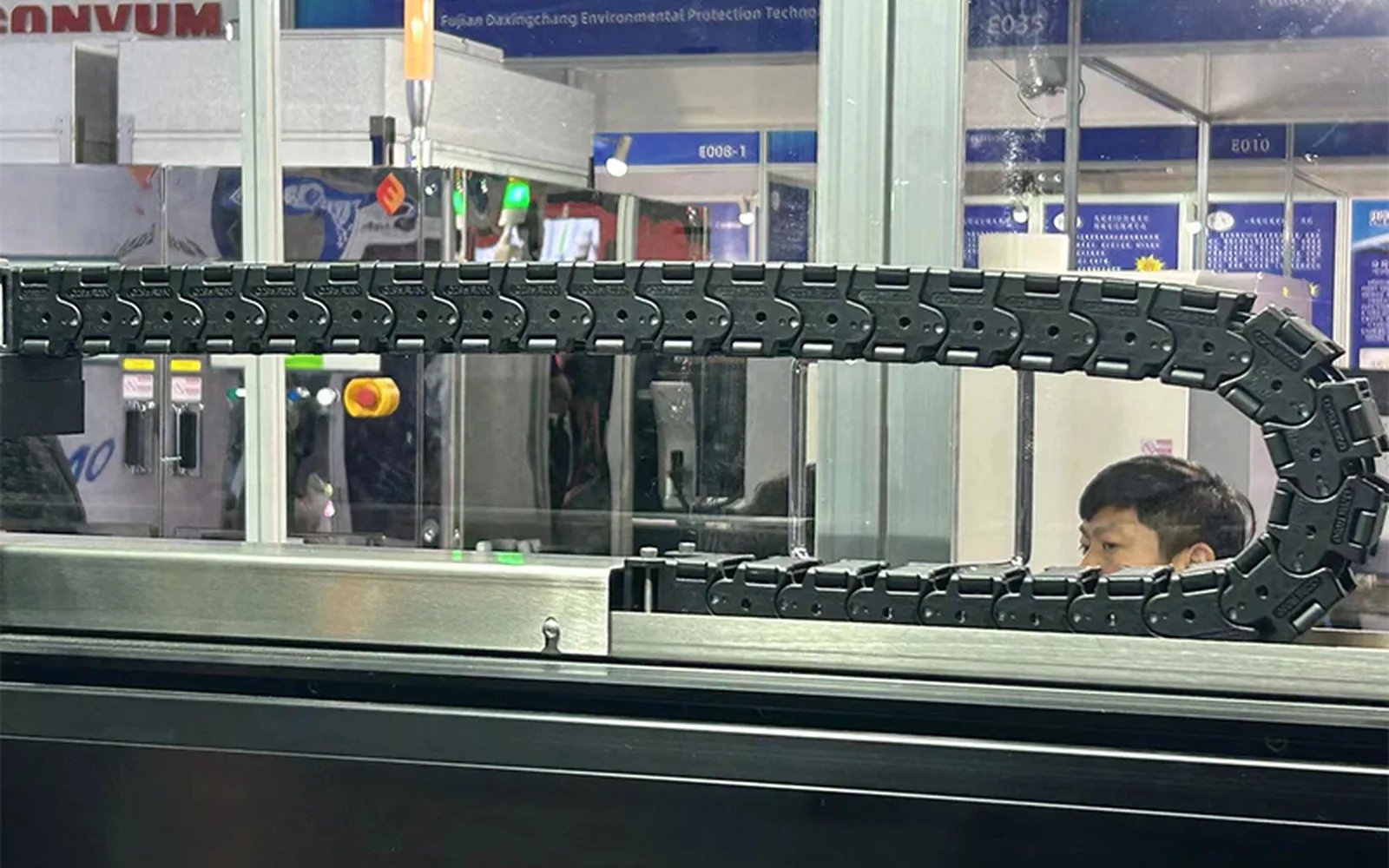
For the cable, high-flex and abrasion-resistant jackets are not optional here. A standard jacket on a cutting table typically fails at the point where the chain reverses direction, and the scoring looks like chain damage in the photograph.
Where plastic is the right call, and where it is not
Plastic makes sense on the moving gantry: lower mass, lower inertia, less motor load, and no corrosion from coolant or water-table mist.
It does not make sense where molten slag lands directly on the chain, or where a hot slug can sit on the cover. In that case the fix is a shield — a steel plate above the run, or a re-route — not a different plastic. We do not make steel carriers, so we will point at the shield rather than sell you something that will not last.
Sizing notes for cutting tables
- Take the acceleration from the drive — The value in the controller, not the average from the cycle time. Peak acceleration at reversal is what loads the chain.
- Leave headroom in the cavity — At 60 % fill or below the cables can move; above that the jacket rubs and the wear particles become the next failure.
- Check the loop at end of stroke — On short tables the return loop can foul the frame. Confirm the bend arc clears before ordering.
Specification at a glance
| Series | Medium / silent / heavy-duty |
|---|---|
| Inner height | 18–80 mm |
| Cover options | Enclosed, semi-enclosed, crossbar |
| Material | PA66 + 30 % GF |
| Life test | ≥ 15 million cycles |
| Warranty | 36 months |
Figures are the range across the series, not a guaranteed value for every size. Confirm the model against your duty before ordering.
Questions buyers ask at this stage
Will a plastic carrier survive a plasma table?+
On the gantry, with enclosed covers and a shield above the run, yes. With molten slag landing directly on the chain, no material choice fixes that — the shield is the fix.
Do you supply steel carriers?+
No. Our range is engineering plastics only. Where steel is genuinely required we would rather say so than substitute something that fails.
What acceleration can the chain take?+
It depends on frame size, fill and cable weight — there is no single number. Send the peak acceleration from the drive and we will size with margin rather than quoting the maximum.
Send the axis data
Peak acceleration, stroke, cable list and a photo of the mounting area. If spatter reaches the chain, tell us — that changes the recommendation more than any other detail.