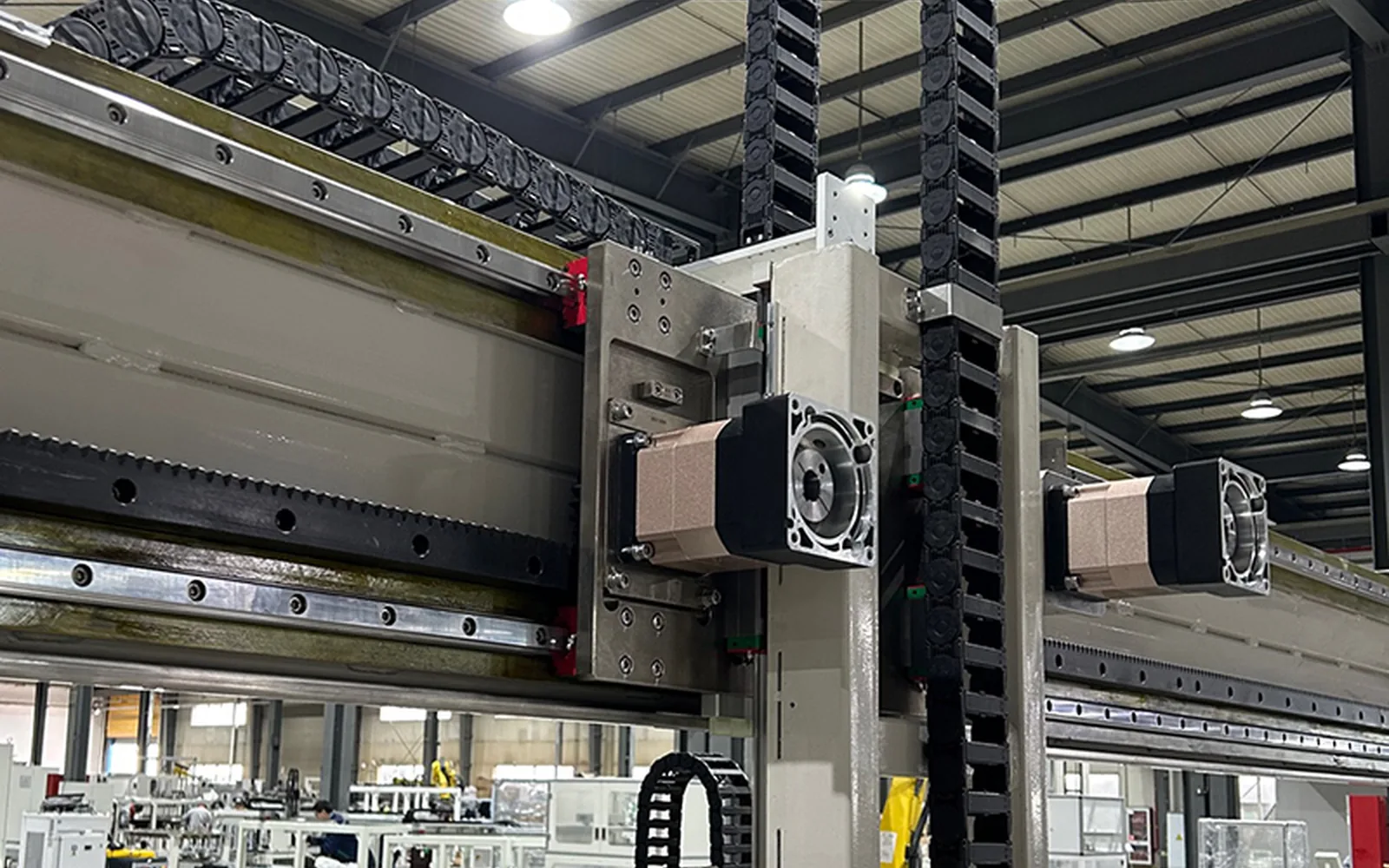
What the environment does to a carrier
- Chips pack the cavity — Fine aluminium and cast-iron swarf works into the gaps between links, bridges across the bend, and turns a rolling contact into a grinding one. This is the single most common cause of short life on machining centres.
- Coolant attacks the surface — Neat cutting oil is tolerable for PA66+GF30. Water-miscible coolant with high pH, or washdown with alkaline detergent, is not — it attacks the surface and accelerates pin wear.
- Heat from the process — Near a spindle or a grinding zone the ambient is higher than the shop floor. Check the continuous temperature against the material, not the peak.
- Duty above the datasheet — Machine tools accelerate hard. Acceleration damages a chain far more than top speed, and it is usually missing from the enquiry.
Enclosed or open: a decision rule
Open carriers with high cover density are enough for wood dust, general automation and clean chip-free environments. They are easier to inspect and cheaper.
Go enclosed when any of the following is true: fine chips that bridge, wet machining with flood coolant, grinding or plasma where abrasive dust is airborne, or an operator who will not clean the chain. Enclosed covers turn a chip-packing problem into a wiping problem.
Sizing that holds up
Sum the cable and hose outer diameters — outer diameter, not conductor cross-section — apply a 1.1 to 1.2 layout factor for spacing, and keep the total under about 60 % of the cavity area. Imported chains often publish life figures measured at around 50 % fill, so a chain sized to 60 % will not deliver the same cycle count.
Pitch is the number most often ignored. Over the same one-metre mounting length, a 30 mm pitch and a 46 mm pitch differ by a dozen links, and the bend path lands somewhere else. Measure the old chain before ordering rather than matching height and width only.
Failures we see, and what actually fixes them
- Side-plate wear at the bend — Usually fill ratio or a misaligned mounting, not a material defect. Check the cavity first.
- Broken link near the moving end — Shock load from an aggressive acceleration ramp. Reduce the ramp or move up one frame size.
- Cable jacket scored lengthwise — Chips trapped between cable and chain, or a separator missing. Add vertical separators and a shelf.
- End fitting fatigue — Often the adapter, not the chain. Check that the bracket is flat against the machine and that the bolts are not in shear.
What we do not make
Our range is plastic only — PA66+GF30 and TPU. We do not produce steel carriers.
If your duty genuinely needs steel — very high loads, hot chips landing directly on the chain, or spans beyond what a plastic chain can carry — then steel is the right answer and it should come from a supplier who makes it. We would rather say that at the enquiry stage than take an order that fails in the field.
Specification at a glance
| Series | Medium / heavy-duty / silent |
|---|---|
| Inner height | 18–80 mm |
| Material | PA66 + 30 % GF; TPU for cleanroom duty |
| Cover options | Enclosed, semi-enclosed, crossbar |
| Life test | ≥ 15 million cycles on the bench |
| Warranty | 36 months |
| Factory | Yueqing, Zhejiang — one plant, open to audits |
Figures are the range across the series, not a guaranteed value for every size. Confirm the model against your duty before ordering.
Questions buyers ask at this stage
Can you replace a chain without changing the mounting brackets?+
Sometimes. Pitch and mounting-hole spacing have to line up; if they do not, an adapter plate is the cheaper route. Send a photo of the old end fitting with a ruler in frame and we can usually tell you before you order.
Do you hold stock for machine-tool sizes?+
Standard sizes in the medium and heavy series ship in one to three days. Non-standard widths and colours are made to order. We do not claim stock on every combination — ask and we will give you the actual position.
Will a plastic carrier survive cast-iron dust?+
With an enclosed cover, yes, provided the cover is wiped at service intervals. Open carriers in cast-iron dust fail quickly. If the machine cannot be cleaned regularly, specify enclosed.
Tell us the machine and the duty
Machine model, old chain dimensions if you have them, cable list and the acceleration ramp. If the old chain failed, a photo of the failure point is worth more than a datasheet.