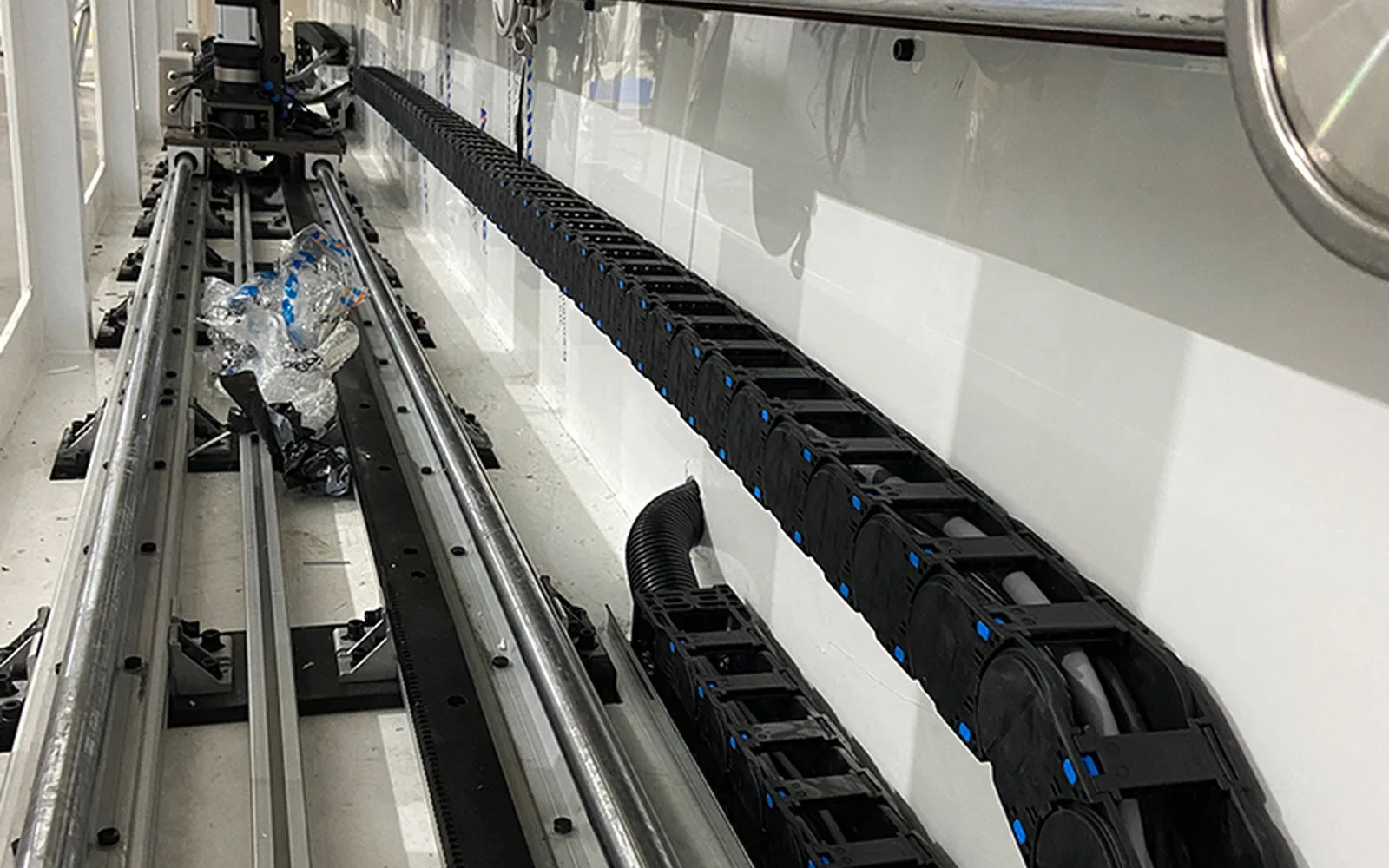
What these lines demand
- Uptime over unit price — A carrier that costs a little more and runs three years beats a cheaper one that stops the line in month eight. We quote cycle life with the test conditions attached so the comparison is real.
- Repeatable spares — Lines run for a decade. The same model number has to be available in year eight, in the same dimensions. That is a supply-chain question as much as an engineering one.
- Documentation — Material records, dimensional reports and declarations are usually required before the first delivery, not after.
- Colour and identification — Colour coding by line or by station is common, and it makes maintenance faster. Standard colours are black and white; others are made to order.
What we can put in a qualification package
IATF 16949:2016 and ISO 9001:2015 certificates; material batch records for the compound used; dimensional inspection reports against the drawing; RoHS and REACH declarations; and the 15-million-cycle bench test record with its conditions.
What we are not going to pretend: if your process requires a full PPAP submission with an approved PSW, raise it at the RFQ stage so we can confirm scope before you plan around it. Committing to a document set we cannot produce is worse for both sides than saying so early.
Where EV lines differ from traditional body shops
- Longer travel on battery assembly — Module and pack lines use long strokes with heavy cable bundles. Frame size and fill ratio matter more than speed here.
- Static control in electrode areas — Anti-static compounds are available, but they are a different material and carry different wear behaviour. Specify it as a requirement, not as an assumption.
- Dust from electrode cutting — Fine conductive dust is unforgiving. Enclosed covers plus a scheduled wipe is the workable combination; open carriers in that zone clog.
- Higher duty cycles — Three-shift operation with short cycle times adds up faster than most duty estimates assume. Calculate cycles per year before comparing life figures.
One plant, open to audit
Production is in Yueqing, Zhejiang. It is our only manufacturing site. Shenzhen and Changzhou are sales offices, and we say that plainly because supplier audits in this industry check exactly this claim.
Visits are welcome with notice. If your process requires a witness audit of the mould shop or the assembly line, it can be arranged.
Specification at a glance
| Certification | IATF 16949:2016, ISO 9001:2015 |
|---|---|
| Series | Medium / heavy-duty / silent / cleanroom |
| Inner height | 18–80 mm (5–80 mm across the range) |
| Material | PA66 + 30 % GF; TPU; anti-static compound on request |
| Life test | ≥ 15 million cycles, conditions on record |
| Warranty | 36 months |
| Manufacturing site | Yueqing, Zhejiang — single plant |
Figures are the range across the series, not a guaranteed value for every size. Confirm the model against your duty before ordering.
Questions buyers ask at this stage
Are you IATF 16949 certified?+
Yes. Certificate T183571 / IATF 0608594, issued 2026-07-11 and valid to 2029-07-10, audited by NQA. The certificate PDF is available on request for your supplier file.
Can you supply PPAP?+
Raise it at RFQ. Some elements we can supply directly, others depend on the scope and the customer-specific requirements. We will confirm what is achievable in writing before you commit to a timeline.
Do you keep spares for a line that runs for ten years?+
The model range is stable and we hold the moulds in-house — over 3,000 of them. For long programmes we recommend agreeing a spares quantity at the start rather than relying on availability in year eight.
Send the line data, not just the part number
Cycles per year, stroke, cable list, ambient conditions and the documentation you need at delivery. With those five we can quote something that survives the audit and the line.