Cable carriers for medical and food equipment
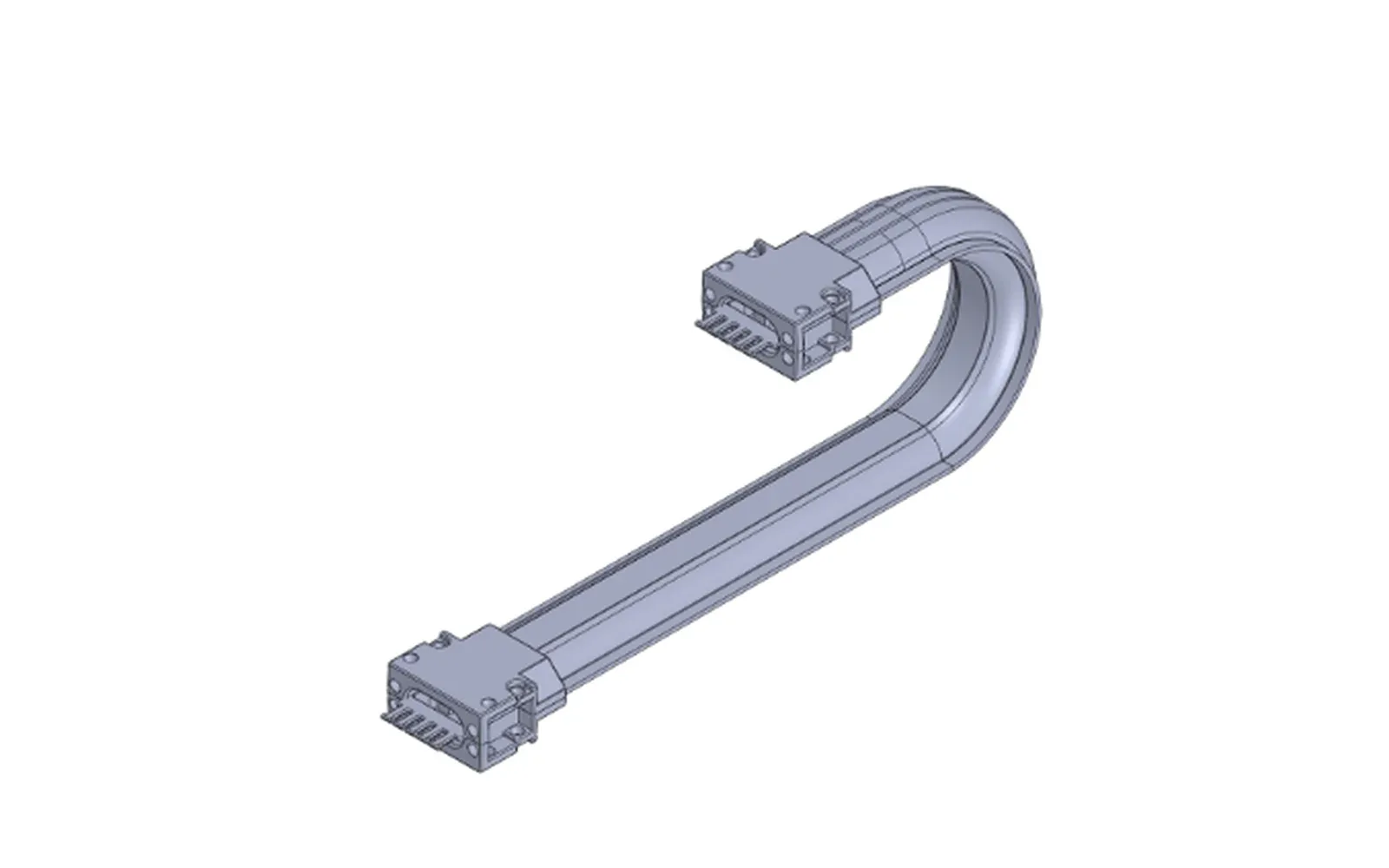
Cleanrooms control particles; hygienic design controls microbes and residue. Covers TPU vs nylon in washdown, four hygienic points and where WWC fits.
The question usually comes in one sentence: "Do you have a food-grade or medical-grade cable carrier?" But those two words sit on completely different acceptance logics. Mix them up and the chain that passes in a cleanroom will crack within three months on a washdown station — and the reverse happens too.
Let's separate the two requirements first, then talk about models.
Cleanroom controls particles, hygienic design controls microorganisms
The cleanroom side looks at airborne particle concentration. ISO 14644-1:2015 classifies air cleanliness by particle count per unit volume. That is an input condition to be written into the technical agreement at the selection stage, not a result to be verified after installation.
The companion standard ISO 14644-14:2026 covers how to assess whether equipment is suitable for use in a cleanroom. One passage deserves reading word by word: it explicitly does not apply to biocontamination assessment, validation of cleaning agents and cleaning methods, the cleanability of equipment and materials, or the physical properties of materials (including electrostatic behaviour). In other words, the cleanroom standard itself admits it governs particle emission, not whether something can be washed clean.
"Hygienic design" on food and medical equipment governs exactly the other end: whether microorganisms can grow inside, whether cleaning agent residues can be rinsed away, whether there are dead corners holding liquid. The whole EHEDG methodology circles those few words.
The two sets do not substitute for each other. A cleanroom particle report proves nothing about cleanability; a cleanability statement proves nothing about particle emission.
A cable carrier is inherently not a "hygienic component"
Links must rotate relative to each other, so gaps are unavoidable. Gaps hold water, swarf and cleaning residue. Full hygienic design in the EHEDG sense — no dead corners, cleanable in place, self-draining — cannot be achieved on a chain that is still moving.
So the realistic approach is layered:
- Cable carriers on food and medical equipment are almost always inside a guard, or in a position with splash but no direct product contact;
- What actually needs hygienic design and certification is the conveyor belt, seals, frame and tank interior, not the carrier;
- If a supplier claims "our carrier is EHEDG certified", ask for the certificate number and the covered model list first. A moving part holding a hygienic certificate deserves a follow-up question.
State this boundary first and the selection conversation becomes real. A customer who sees you are not selling a "universal hygienic chain" is more likely to hand over the actual operating conditions.
Washdown duty: where nylon and TPU actually differ
This is the most substantive technical fork in medical and food applications, and it comes down to three things.
Moisture absorption. Nylon absorbs moisture; it swells and loses stiffness as it does. Repeated wash-dry cycles mean the links keep expanding and contracting. The dimensional change is small, but it affects pitch fit and running smoothness.
Hydrolysis. The amide bonds in nylon hydrolyse in warm, mildly alkaline or acidic cleaning agents, faster at higher temperature. Alkaline foam cleaners at 60 °C and above are not a friendly environment for nylon.
Wear and self-lubrication. Nylon wins here: glass-fibre reinforcement gives high stiffness and load capacity, and dry-running life is long.
TPU has no amide bond, so its hydrolysis resistance is fundamentally better — but it depends on the soft segment. Polyether-based TPU resists hydrolysis noticeably better than polyester-based. Which one a given grade uses must be confirmed with the material supplier; "TPU is hydrolysis resistant" is not a safe blanket statement.
In practice:
| Duty | Preferred material | Reason |
|---|---|---|
| Frequent washdown, alkaline agents, hot and humid | TPU | No moisture uptake, better hydrolysis base |
| Dry cleanroom, no washdown | Glass-fibre reinforced nylon | Stiff, high load, lower cost |
| Oil mist but no water | Either | Decide by bundle weight and travel |
For a fuller material comparison, see nylon vs TPU vs steel.
Four points of hygienic design
Forget certification for a moment and list only what can be checked on site. Four items:
| Point | Requirement | Why |
|---|---|---|
| Drainable | Bend opening facing down, running length on a 2–3° slope | Trapped water in a U-bend is the most common starting point for growth |
| No liquid pockets | Closed type, not open/bridge type | Open links store water and debris directly |
| No lubrication | No grease at all, and no oily cloth when cleaning | Grease is both a residue source and a particle source |
| Rinsable | Smooth surface, removable end brackets | Rinse water must be able to carry residue away |
None of these need a third-party certificate. During acceptance, shining a torch into the link cavity and feeling for standing water tells you more than a certificate.
Where the rinse water goes matters more than which model
This is the most underestimated item on site. The same WWC18 fails in three months mounted with the bend facing up, and lasts years mounted with the bend facing down plus a drainage slope.
Three actions:
- On a vertical axis, always orient the bend downwards so water runs along the links instead of pooling in the cavity;
- Put a 2–3° slope on horizontal running lengths, falling towards the drain side;
- Do not create an upward step at either interface between the carrier and the machine.
There is a subtler point: after washdown, residual water inside the link cavity evaporates very slowly. The next morning it is still wet inside. That is the most common origin of microbial growth — more common than choosing the wrong material, and no material change will fix it.
Chemical compatibility: nothing resists everything
Typical agents in medical and food plants: 70% isopropanol, hydrogen peroxide, sodium hypochlorite, quaternary ammonium, peracetic acid.
- TPU is sensitive to strong oxidisers (hypochlorite, peracetic acid); prolonged contact causes discolouration, surface tackiness, then cracking;
- Nylon is equally unhappy with hypochlorite;
- Alcohols are comparatively mild, but "alcohol resistant" does not mean "peracetic acid resistant" — the oxidising strength differs by orders of magnitude.
The correct validation is an immersion test at the customer's actual concentration, temperature and contact time, measuring four things: mass change, dimensional change, Shore hardness change, tensile strength retention. Pass/fail criteria belong in the agreement; "chemical resistant" alone is not a specification.
We do not make verbal commitments on these numbers. Where needed, testing is arranged with a third party for the specific agent.
The IP rating gets misquoted constantly
The IP code in IEC 60529 is an enclosure rating: it grades how well an electrical enclosure keeps out solid objects and water. A cable carrier is not an enclosure; it is a cable guiding device and carries no IP rating of its own.
So "IP67 cable carrier" is usually a sign of sales patter. What actually matters is two places:
- Where cables enter the link cavity — is there strain relief and sealing;
- The run from the carrier outlet to the control cabinet — is it separately protected.
For complete electrical requirements see IEC 60204-1; for the machinery risk assessment logic see ISO 12100. Both are machine-level documents, not carrier specifications.
What the WWC range covers: 15 to 35 mm inner height
The WWC cleanroom range is the only TPU line we make. Standard positions (non-standard sizes assessed separately):
| Model | Inner height | Inner width | Available bend radii |
|---|---|---|---|
| WWC15 | 15 mm | 25 mm | R40 / R50 / R60 / R70 |
| WWC18 | 18 mm | 32 mm | R40 / R50 / R60 / R70 |
| WWC22 | 22 mm | 40 mm | R40 / R50 / R60 / R70 |
| WWC28 | 28 mm | 65 mm | R40 / R60 / R70 / R90 |
| WWC35 | 35 mm | 65 mm | R60 / R70 / R90 |
Material TPU, operating temperature -20 °C to +120 °C, lubrication-free.
Mapped to medical and food equipment:
- Analytical instruments, sample handling, imaging tables, small labellers — thin bundles, short strokes: mostly WWC15 and WWC18;
- Filling and packaging lines with heavier bundles: WWC22 through WWC35.
The limits deserve equal space: TPU is less stiff than glass-fibre reinforced nylon and has limited unsupported span, and the maximum bend radius is only R90. Beyond 2 m of travel, or with a heavy bundle, it is not the right product — add support or change approach. Using WWC to replace a long-travel heavy-duty chain is the wrong direction from the start. For the calculations see how to work out bend radius and how to work out chain length.
Dry-duty small medical devices: micro nylon is the better fit
Not every medical device needs a cleanroom chain. Clinic equipment, analyser lines, dental and ophthalmic devices run dry with no washdown, and micro nylon is more economical — stiffer, cheaper, denser size range.
| Series | Inner height | Inner width | Available bend radii |
|---|---|---|---|
| Series 5 | 5 mm | 5–7 mm | R10 / R15 |
| Series 7 | 7 mm | 7–10 mm | R15 |
| Series 10 | 10 mm | 6–40 mm | R18 / R28 / R38 |
| Series 15 | 15 mm | 15–50 mm | R28 / R38 / R48 |
Material is glass-fibre reinforced nylon, same -20 °C to +120 °C range. These must not go into a washdown zone — the moisture uptake and hydrolysis issues above apply. For width sizing see how to choose inner width.
Medical devices: when a cleanroom grade is genuinely required
Three questions, in order.
First, does the carrier contact the patient? Normally not. It is an internal cable routing part; what touches the patient is the probe, the table, the fixture. Without contact, the biological evaluation under ISO 10993-1:2025 generally does not land on the carrier. If it does, that is the device manufacturer's responsibility, decided by contact nature and duration.
Second, is the machine installed inside a clean zone? If it goes into a sterile area or an ISO 5–7 cleanroom, classify per ISO 14644-1 and use a cleanroom-grade chain; if it sits in an ordinary workshop, micro nylon is enough. Sterile areas in pharmaceutical production additionally fall under EU GMP (EudraLex Volume 4), whose acceptance clauses are more specific than those for devices.
Third, does the machine go through MDR or 510(k)? If so, every material declaration in the BOM may be requested by the reviewer. Prepare the documents early; see the general safety and performance requirements in EU MDR 2017/745.
One frequent misunderstanding to clear up: ISO 13485 is a quality management system requirement for medical device manufacturers, not a component certificate. When a customer asks "are you 13485 certified", the correct answer is: we hold IATF 16949 and ISO 9001; 13485 is the device maker's own system, and as a component supplier we provide documents against the customer's supplier audit checklist. Claiming otherwise falls apart at the first audit.
Food equipment: how far our food-contact compliance actually goes
On the EU side, plastic food-contact materials fall under EU 10/2011, built on a positive list plus migration limits; on the US side, rubber articles for repeated use are covered by 21 CFR 177.2600, which sets extractive limits.
Whether you need that paperwork comes down to one prior question: does the carrier directly contact food?
- Inside a guard, receiving only splash and cleaning agent: usually no food-contact conformity declaration is needed;
- Direct food contact, or condensate and debris dripping onto the chain from above: then it is needed.
Our position, stated plainly: we can supply a material description (TPU or glass-fibre reinforced nylon), RoHS and REACH per batch, and third-party testing on a project basis. A food-contact material conformity declaration must be confirmed separately for the specific grade and end use — we do not assume it can be issued.
Say this before the quotation, not after. Discovering a missing FCM declaration at acceptance is far more expensive than one extra sentence at quotation stage. How to obtain test reports is covered in the download centre.
Acceptance checklist: put the requirements into the technical agreement
"We need a hygienic one" always ends in an argument. Work through this table instead:
| Item | What to write | Reference |
|---|---|---|
| Cleanliness class | Target ISO Class + sampling points + method | ISO 14644-1 |
| Equipment suitability | Assess suitability by particle concentration | ISO 14644-14 |
| Material | Grade + colour + hardness, with material certificate | Supplier declaration |
| Chemical resistance | Agent + concentration + temperature + contact time + criteria | Immersion test |
| Cleaning method | Pressure + temperature + agent + frequency | Customer process document |
| Resistance (if required) | Volume/surface resistance range + test humidity | ANSI/ESD S20.20 |
| Life | Cycles at stated stroke and speed | Bench test |
| Documents | RoHS / REACH / material cert / test reports, per batch | Order agreement |
The two rows most often skipped are cleaning method and chemical resistance — precisely the two that cause most field failures.
If the customer also raises ESD (the test basis is ANSI/ESD S20.20), note that it and cleanliness are two different things and their reports cannot substitute for each other. See antistatic cleanroom carriers. Front-end semiconductor equipment is stricter still; see carriers for semiconductor equipment.
Three common misjudgements
Cleanroom equals washable. No. Cleanroom grade governs particle emission; washability governs hydrolysis resistance, chemical resistance and drainage. A chain with extremely low emission will still fail in an alkaline cleaning agent.
A carrier has an IP rating. No. IP is an enclosure rating; a carrier is a guiding device and carries none. If you need protection, seal the interfaces — do not look for an IP number on the chain.
Food-grade TPU. Usually a marketing phrase. TPU is a material family; whether it may contact food depends on whether the specific grade is on the positive list and whether migration data exists. The family does not decide it.
How to confirm the right model
To give an accurate selection we need: equipment type and mounting orientation, whether there is washdown and by what method, cleaning agent type with concentration and temperature, cleanliness class if any, travel and speed, number of cables and total outer diameter, and whether a document package is required.
Send those over and we will work through the 8-step selection method and come back with model recommendations and drawings. Standard models are in stock; sample validation can also be arranged.
Product data is on the WWC cleanroom range and the micro carrier range; anything else, contact us.